Today's
EarthStation1.com 15% Off Commemorative Memorial Title: The Orson
Welles Radio Anthology MP3 MegaSet DVD, Download, USB Drive
Today, December 31, 2025
December 31: National Champagne Day: -- A
timely annual recognition of the wine that puts the pop in every
New Year's Eve celebration! Genuine champagne only comes from
France's Champagne region. French law protects where and how it is
made. With some exceptions, only Champagne made according to set
specifications and within the French region may label their wines
using the term "Champagne." Other foods and beverages
fall under this type of protection in France and other parts of
the world. Champagne, France, is located northeast of Paris and
provides the ideal temperature and soil to produce the grapes
required for Champagne. French law allows only eight varieties of
grapes for the production of Champagne in the Champagne region.
Primarily, the three grapes used to create Champagne are
Chardonnay, Pinot Noir, and Pinot Meunier. Unlike other wines,
Champagne ferments in the bottle allowing the vintner to trap the
CO2 in the bottle. The bubbles give Champagne its effervescence.
While Champagne can be spendy, if you are looking for a little pop
on New Year's Eve, other varieties of sparkling wine are available
from Italy, California, and even the South of France. They offer a
sparkle that won't put a fizzle in your pocketbook. Then again,
some New Years mean an opportunity for splurging and celebrating
no matter the expense. So go on, pop open a bottle of your
favorite champagne (and remember always to drink responsibly and
never drink and drive) - and when you do, Try these food pairings
while you celebrate: 1) Something smoky - Try smoked salmon or a
dish made with smoked gouda or another favored cheese, especially
if the Champaign is acidic; 2) Satisfy your sweet tooth - If
you're leaning toward a sparkling wine like a Moscato, berries,
citrus and dainty pastries bring in the New Year quite well; and
3) Spice it up - Many Champagnes hold up to the heat of spicy
entrees and appetizers, so celebrate all night long with these
flavors! However to do, use #NationalChampagneDay to post about it
on social media! On Sale @ 15% Off Discount Till Midnight PT!
https://store.earthstation1.com/orson-welles-radio-mp3-dvd-complete-broadcast3.html
Today's
EarthStation1.com 15% Off Commemorative Memorial Title: Those
Oldies But Goodies Rock & Roll Doo-Wop MP3 Set DVD Download
USB
Today, December 31, 2025
December 31, 1907: New Year's Eve (Old
Year's Day): -- The first annual New Year's Eve Times Square Ball
Drop is held at Times Square in Manhattan (then known as Longacre
Square, renamed after The New York Times moved its headquarters to
the new Times Building, today's One Times Square), in celebration
of New Year's Eve and signifying the start of the New Year at
midnight. The Times Square Ball is a time ball, an obsolete
time-signalling device that historically consisted of a large,
painted wooden or metal ball dropped at a predetermined time,
principally to enable navigators aboard ships offshore to verify
the setting of their marine chronometers so that accurate
timekeeping could be kept, which is essential to the determination
of longitude at sea. Although the use of time balls has been
replaced by electronic time signals, some time balls have remained
operational as historical tourist attractions, and in the case of
the Times Square Ball, as part of public celebrations. The Times
Square Ball is located on the roof of One Times Square, and it
descends down a specially designed flagpole beginning at 11:59:00
p.m. ET, and resting at midnight to signal the start of the new
year. In recent years, the festivities have been preceded by live
entertainment, including performances by musicians. The event was
first organized by Adolph Ochs, owner of The New York Times
newspaper, as a successor to a series of New Year's Eve fireworks
displays he held at the building to promote its status as the new
headquarters of the Times, while the ball itself was designed by
Artkraft Strauss. The ball drop has been held annually since
December 31, 1907, except in 1942 and 1943 in observance of
wartime blackouts. The ball's design has been updated over the
years to reflect improvements in lighting technology; the ball was
initially constructed from wood and iron, and lit with 100
incandescent light bulbs. The current incarnation features a
computerized LED lighting system and an outer surface consisting
of triangular crystal panels. These panels contain inscriptions
representing a yearly theme. Since 2009, the current ball has been
displayed atop on Times Square year-round, while the original,
smaller version of the current ball that was used in 2008 has been
on display inside the Times Square visitor's center. The event is
organized by the Times Square Alliance and Countdown
Entertainment, a company led by Jeff Strauss, and is among the
most notable New Year's celebrations internationally. It is
attended by at least 1 million spectators yearly, and is
nationally televised as part of New Year's Eve specials broadcast
by a number of networks and cable channels. The prevalence of the
Times Square ball drop has inspired similar "drops" at
other local New Year's Eve events across the country; while some
use balls, some instead drop objects that represent local culture
or history.. The last evening of the Gregorian calendar year, New
Year's Eve is traditionally a night for merry-making to welcome in
the new year. On Sale @ 15% Off Discount Till Midnight PT!
https://store.earthstation1.com/those-oldies-but-goodies-rock-amp-roll-doo-wop-mp3-dv3.html
Today's
EarthStation1.com 15% Off Commemorative Memorial Title: The Celts
TV Series On Celtic History & Culture DVD Download USB Drive
Today, December 31, 2025
December 31: Hogmanay: -- It is thanks to
the Hogmanay custom of singing "Auld Lang Syne" that
"Auld Lang Syne", the Scots poem by Robert Burns based
on traditional and other earlier sources, that this song is sung
worldwide on New Year's Eve at the stroke of midnight. Hogmanay is
an annual new year's celebration when Scots host house parties and
exchange gifts. The celebrations are often followed by parties on
both New Year's Day and January 2, which is a bank holiday in
Scotland. Hogmanay is a Scottish word meaning "the last day
of the year." While the origins of Hogmanay are hard to
pinpoint, its roots are thought to lie in Norse and Gaelic
traditions. In a few contexts, the word Hogmanay is used more
loosely to describe the entire period consisting of the last few
days of the old year and the first few days of the new year. For
instance, not all events held under the banner of Edinburgh's
Hogmanay take place on December 31. Customs vary throughout
Scotland and usually include gift-giving and visiting the homes of
friends and neighbours, with particular attention given to the
"first-foot", the first guest of the new year. The
etymology of the word is obscure. The earliest proposed etymology
comes from the 1693 Scotch Presbyterian Eloquence, which held that
the term was a corruption of a presumed Ancient Greek "Hagia
Mene ("Holy Month"). The three main modern theories
derive it from a French, Norse or Gaelic root. It is speculated
that the roots of Hogmanay may reach back to the celebration of
the winter solstice among the Norse, as well as incorporating
customs from the Gaelic celebration of Samhain. The Vikings
celebrated Yule, which later contributed to the Twelve Days of
Christmas, or the "Daft Days" as they were sometimes
called in Scotland. Christmas was not celebrated as a festival,
and Hogmanay was the more traditional celebration in Scotland.
This may have been a result of the Protestant Reformation after
which Christmas was seen as "too Papist". Hogmanay was
also celebrated in the far north of England, down to and including
Richmond in North Yorkshire. It was traditionally known as
'Hagmena' in Northumberland, 'Hogmina' in Cumberland, and
'Hagman-ha' or 'Hagman-heigh' in the North Riding of Yorkshire.
There are many customs, both national and local, associated with
Hogmanay. The most widespread national custom is the practice of
first-footing, which starts immediately after midnight. This
involves being the first person to cross the threshold of a friend
or neighbour and often involves the giving of symbolic gifts such
as salt (less common today), coal, shortbread, whisky, and black
bun (a rich fruit cake), intended to bring different kinds of luck
to the householder. Food and drink (as the gifts) are then given
to the guests. This may go on throughout the early morning hours
and into the next day (although modern days see people visiting
houses well into the middle of January). The first-foot is
supposed to set the luck for the rest of the year. Traditionally,
tall, dark-haired men are preferred as the first-foot. An example
of a local Hogmanay custom is the fireball swinging that takes
place in Stonehaven, Aberdeenshire, in northeast Scotland. As The
Clock Tower bell, the Old Town House bell of the Old Town Steeple
of Stonehaven Town House located on High Street, sounds to mark
the new year, the balls are set alight, and the swingers set off
up the High Street from the Mercat Cross to the Cannon and back,
swinging the burning balls around their heads as they go. At the
end of the ceremony, fireballs still burning are cast into the
harbour. Large crowds flock to see this spectacle, with 12,000
attending the 2007/2008 event. In the early 2020s, additional
attractions have been added to entertain the crowds as they wait
for midnight, such as a fire poi (fire performance), a pipe band,
street drumming, and a firework display after the last fireball is
cast into the sea. The festivities are now streamed live over the
Internet. In the east coast fishing communities and Dundee,
first-footers once carried a decorated herring. And in Falkland in
Fife, local men marched in torchlight procession to the top of the
Lomond Hills as midnight approached. Bakers in St Andrews baked
special cakes for their Hogmanay celebration (known as "Cake
Day") and distributed them to local children.. On Sale @ 15%
Off Discount Till Midnight PT!
https://store.earthstation1.com/the-celts-dvd-set-tv-series-all-6-shows-celtic-history-3-dis63.html
Today's
EarthStation1.com 15% Off Commemorative Memorial Title: WABC Radio
Airchecks MP3 Collection 1960s-1980s DVD, MP3 Download, USB
Today, December 31, 2025
December 31: Make Up Your Mind Day: -- As
the title of the monster hit song by The Lovin' Spoonful directs,
December 31st encourages us to quit wavering, to take a side, and
follow through with a decision and stick to it! As New Year's
resolutions go, this may be the day to decide which ones to
declare. The day may be used to determine other decisions as well.
Career changes, family decisions, and large purchases often keep
us from moving forward. We waver between multiple choices or
sometimes a simple yes or no. While some life-altering decisions
are made on a whim, most people deliberate and weigh the pros and
cons before making these types of decisions. If a decision has you
hesitating, make a decision. This day is the incentive to make a
choice. Draw up a list of pros and cons to help you decide. Too
many choices? Pare them down by ranking them. Use
#MakeUpYourMindDay to post on social media! On Sale @ 15% Off
Discount Till Midnight PT!
https://store.earthstation1.com/wabc-musicradio-shows-mp3-dvd-60s80s-am-360807775.html
Today's
EarthStation1.com 15% Off Commemorative Memorial Title: The Hands
Of Time... A Story On American Clocks DVD, MP4, USB Drive
Today, December 31, 2025
December 31: Leap Second Time Adjustment
Day: The majority of the world measures time solely based on a 24
hour day in which each hour contains 60 minutes, and each minute
contains 60 seconds. That measurement is much too simple for
accurate time measurement. Since about 140 AD, scientists have
attempted to break down the hours in the day into a consistent and
precise means of measure. Due to the variability of the Earth's
rotation, measurement of the 24 hour day is not an exact science.
There is some dispute over the validity of leap second
adjustments. Some years scientists do not make adjustments. But,
if they do, then it's done on either June 30 or December 31.
Beginning in 1972, when the leap-second system was first
introduced, scientists have added 27 leap seconds as of 2022.
Another factor impacting the atomic clock is the fact that the
Earth's rotation is slowing, which means the length of our day is
getting longer. Whether an adjustment is made or not, here are
ways to celebrate #LeapSecondTimeAdjustmentDay: Watch an episode
of Quantum Leap. Play the game leapfrog. Listen to "Leap of
Faith" by Bruce Springsteen. Sneak up on someone and see if
you can scare them into leaping into the air. Leap for joy. Watch
the moon landing and listen for Neil Armstrong's famous quote.
Sing the 12 Days of Christmas and see if you remember which day
leaps. Take a leap of faith. Whatever you do to lord your leaping,
use #LeapSecondTimeAdjustmentDay to post on social media! On Sale
@ 15% Off Discount Till Midnight PT!
https://store.earthstation1.com/the-hands-of-time-a-story-on-american-clocks-dvd.html
Today's
EarthStation1.com 15% Off Commemorative Memorial Title: United
Nations Documentaries Set: 2 MP4 Downloads Or 2 DVDs
Today, December 31, 2025
December 31: Universal Hour Of Peace
(World Peace Meditation Day): -- From 11:30 p.m. on December 31st
to 12:30 a.m. on January 1st each year, Universal Hour of Peace
hopes to take a step toward a war-free world by encouraging
peaceful activities during the hour of observance. Organizations
around the world host events supporting an hour of peace. Some
include prayer, music, poetry, or speeches. While gatherings may
be large or small, the effort overall will be to spread the word
of peace in every heart and mind regardless of faith. Several ways
to participate include: Host a prayer circle; Join a candlelight
vigil; Meditate or attend a meditation session; Organize an event
to discuss drawing us closer to peace; Share resources for
promoting harmony in communities; Participate in discussions that
bring organizations together to create solutions to issues; Share
an experience; Write a poem or story; and use
#UniversalHourOfPeace to post on social media. Dr. Barbara Condron
at the School of Metaphysics conceived the first Universal Hour of
Peace. The world celebrated the first Universal Hour of Peace on
October 24, 1995. It coincided with the 50th anniversary of the
United Nations and the autumnal equinox. The following year it was
moved to January 1st at Noon GMT. It is now celebrated from 11:30
p.m. December 31st to 12:30 a.m. January 1st. On Sale @ 15% Off
Discount Till Midnight PT!
https://store.earthstation1.com/united-nations-documentaries-set-dvd-mp4-download-usb-driv4.html
Today's
EarthStation1.com 15% Off Commemorative Memorial Title: The Old
Time Radio Sci-Fi & Paranormal MP3 MegaSet CD, Download, USB
Today, December 31, 2025
December 31: Unlucky Day: -- Sometimes
life can feel like a rollercoaster. Embrace the challenges, learn
from them, and keep pushing forward towards your goals. Turn back
the clock and forget about any bad luck that happened throughout
the previous year and leave everything behind on Unlucky Day. It's
the day for looking forward to what's ahead and getting rid of
anything unfortunate! The idea of luck goes back far in human
history and has developed in different ways throughout various
cultures. For instance, in Chinese culture, the number 4 is
considered unlucky which may be because of the fact that the
number is a homophone for the word that means death. And in
Western culture, the idea of opening an umbrella indoors has been
considered unlucky, which may be due to its ability to insult the
sun god. In the English language, the term "luck"
probably came from the term "luc" or "gheluc"
meaning good fortune in Middle Dutch, which was probably used in
relation to gambling practices and having a lucky streak. Many
people have often considered Friday the 13th to be unlucky, a day
that comes about two or three times a year on rotating dates. But
Unlucky Day always falls at the very end of the year, making it a
sort of capstone for the entire 364 previous days. On Sale @ 15%
Off Discount Till Midnight PT!
https://store.earthstation1.com/the-old-time-radio-scifi-paranormal-megaset-dual-layer-mp3-dv3.html
Today's
EarthStation1.com 15% Off Commemorative Memorial Title: Frederick
Douglass Biography Documentary DVD MP4 Download USB Drive
Today, December 31, 2025
December 31: Watch Night: -- December 31,
1862: Residents of Rochester, N.Y. join Frederick Douglass,
African-American escaped slave, abolitionist, activist, social
reformer, orator and writer, in a vigil in anticipation of the
Emancipation Proclamation, which went into effect at midnight. The
Emancipation Proclamation by President Abraham Lincoln freed the
slaves in the states rebelling against the Union takes effect. On
September 22, 1862, President Lincoln signed and issued the
proclamation, also known as or Proclamation 95. It was a
presidential proclamation and executive order freeing the slaves
in territories held by Confederates as of January 1, 1863, on a
preliminary basis, publicly warning that he would order the
proclamation to take effect in any state that did not end its
rebellion against the Union by January 1, 1863. None of the
Confederate states restored themselves to the Union, and Lincoln's
order took effect on January 1, 1863. The Emancipation
Proclamation outraged white Southerners (and their sympathizers)
who envisioned a race war. It angered some Northern Democrats,
energized anti-slavery forces, and undermined elements in Europe
that wanted to intervene to help the Confederacy. The Proclamation
lifted the spirits of African Americans both free and slave. It
led many slaves to escape from their masters and get to Union
lines to obtain their freedom, and to join the Union Army. On Sale
@ 15% Off Discount Till Midnight PT!
https://store.earthstation1.com/frederick-douglass-biography-documentary-dvd-mp4-download-usb-driv4.html
Today's
EarthStation1.com 15% Off Commemorative Memorial Title: The Fall
Of The Roman Empire 1964 DVD, Video Download, USB Flash Drive
Today, December 31, 2025
December 31, 192: #DOTD: Commodus, Roman
emperor with his father Marcus Aurelius from 177 until his
father's death in 180, and solely until 192 (b. August 31, 161)
#dies when is assassinated in a plot led by his favorite mistress
(concubine), the previously steadfastly loyal Marcia, whom he had
planned to execute the following morning along with fellow
plotters Laetus (Quintus Aemilius Laetus), a Praetorian prefect,
and Eclectus, Commodus' chamberlain. In November 192, Commodus
held Plebeian Games, in which he shot hundreds of animals with
arrows and javelins every morning, and fought as a gladiator every
afternoon, winning all the fights. In December, he announced his
intention to inaugurate the 193 as both consul and gladiator. To
celebrate the Roman New Year on January 1, 192 AD, Commodus
decided he wanted to make an appearance before the Roman people
not from the palace in traditional purple robes, but from the
gladiator's barracks, escorted by the rest of the gladiators.
After telling his plan to Marcia on December 31, she begged him
not to behave so carelessly and bring disgrace to the Roman
Empire. Commodus, upset by Marcia's reaction, then told his plan
to Aemilius Laetus, the Praetorian Prefect, and Eclectus, his
servant. After they, too, tried to dissuade him, he became furious
and put their three names on a proscribed list of people to be
executed the next morning, including names of prominent senators.
While Commodus was taking a bath, his favorite servant boy
Philcommodus (whose name is a symbol of Commodus' fondness for the
boy) found the tablet on which the list was written and ran into
Marcia while he was holding the tablet. Marcia took it from him,
thinking she was protecting a document from potentially being
ruined, and in horror saw her name at the top of the list.
According to Herodian, she cried out, "Well done, indeed,
Commodus. This is fine return for the kindness and affection I
have lavished on you and for the drunken insults which I have
endured from you all these years. A fuddled drunkard is not going
to get the better of a sober woman". She then gathered
Praetorian prefect Laetus and Eclectus, Commodus' chamberlain, and
the three of them decided they had to kill Commodus in order to
save their own lives. Usually Marcia would give the emperor his
first drink after his bath so he could have the pleasure of
drinking from his lover's hand. It was easy, then, for her to mix
poison into the wine she gave to Commodus after his bath. After
drinking the wine, he became so ill that his vomiting would not
cease. The three conspirators were afraid he would expel all the
poison, so they ordered Narcissus, his wrestling partner, to
strangle Commodus for a large reward. Upon his death, the Senate
declared him a public enemy (a de facto damnatio memoriae) and
restored the original name of the city of Rome from the name
Commodus had changed it to (Colonia Lucia Annia Commodiana) and
its institutions which he likewise renamed. Statues of Commodus
were demolished, and his name was expunged from official records
(Damnatio Memoriae, "Damnation Of Memory", the exclusion
of a person from official accounts). His body was buried in the
Mausoleum of Hadrian. Marcia and Eclectus were thereafter married.
Commodus' death marked the end of the Nerva-Antonine dynasty.
Commodus was succeeded by Pertinax, whose reign was short-lived;
he would become the first Emperor of the tumultuous Year Of The
Five Emperors, and was usurped by Didius Julianus, the second
Emperor of The Year Of The Five Emperors, who soon had Marcia
killed in 193 AD. In 195, the emperor Septimius Severus, trying to
gain favour with the family of Marcus Aurelius, rehabilitated
Commodus' memory and had the Senate deify him. Commodus was born
on August 31, 161 in Lanuvium, near Rome. His reign is commonly
considered to mark the end of the golden period in the history of
the Roman Empire known as the Pax Romana. He accompanied Marcus
his father during the Marcomannic Wars in 172 and on a tour of the
Eastern provinces in 176. He was made the youngest consul in Roman
history in 177 and later that year elevated to co-emperor with his
father. During his solo reign, the Empire enjoyed a period of
reduced military conflict compared with the reign of Marcus
Aurelius, but intrigues and conspiracies abounded, leading
Commodus to an increasingly dictatorial style of leadership that
culminated in a god-like personality cult, with him performing as
a gladiator in the Colosseum. Cassius Dio, a first-hand witness,
described him as lustful and cruel, and there were many attempts
on his life. His assassination in 192 marked the end of the
Nerva-Antonine dynasty. He was succeeded by Pertinax, the first
emperor in the tumultuous Year of the Five Emperors. On Sale @ 15%
Off Discount Till Midnight PT!
https://store.earthstation1.com/the-fall-of-the-roman-empire-1964-dvd-set-aleq-guinness-sophia-l1964.html
Today's
EarthStation1.com 15% Off Commemorative Memorial Title: The
American Adventure: TV History Series 1607-1876 DVD MP4 USB Drive
Today, December 31, 2025
December 31, 1781: Banking: Banking In
The United States: The History Of Banking In The United States:
The Bank Of North America: -- The first bank in the U.S., the Bank
Of North America, receives its charter from the Continental
Congress that had approved its charter on May 26, 1781. It was a
private national bank which served as the United States' first de
facto central bank, and opened on January 7, 1782, at 305-307
Chestnut Street in Philadelphia. The Bank of North America was
based upon a plan presented by US Superintendent of Finance Robert
Morris on May 17, 1781, based on recommendations by Alexander
Hamilton. Failing to gain and maintain sufficient long term
traction in that role, it was succeeded by the also privately held
First Bank of the United States in 1791. In May 1781 Alexander
Hamilton revealed that he had recommended Robert Morris for the
position of Superintendent of Finance of the United States the
previous summer when the constitution of the Articles Of
Confederation-era executive was being solidified. Second, he
proceeded to lay out a proposal for a national bank that would
also serve as a de facto central bank. Morris, who had
corresponded with Hamilton previously on the subject of funding
the war, immediately drafted a legislative proposal based on
Hamilton's suggestion and submitted it to the Congress. Morris
persuaded Congress to charter the Bank of North America, the first
private commercial bank in the United States. The original charter
as outlined by Hamilton called for the disbursement of 1,000
shares priced at 400 USD each. Benjamin Franklin purchased a
single token share as a sign of good faith to Federalists and
their new bank. Hamilton used his pseudonym "Publius"
(later immortalized in the Federalist Papers advocating in the
late 1780s for adoption of the United States Constitution) to
endorse the bank. William Bingham, rumored to be the richest man
in America after the Revolutionary War, purchased 9.5% of the
available shares. The greatest share, however, 63.3%, was
purchased on behalf of the United States government by Robert
Morris using a gift in the form of a loan from France, and a loan
from the Netherlands. This had the effect of capitalizing the bank
with large deposits of gold and silver coin and bills of exchange.
He then issued new paper currency backed by this supply. Thomas
Willing, a twice former mayor of Philadelphia and partner with
Morris in an import-export firm (that included slaving), was named
the bank's first president. He held that office from 1781-1791,
being succeeded by John Nixon, and moving immediately on to become
the first president of the First Bank of the United States, a
position he held from 1791 to 1807. By 1783, Congress and several
states including Massachusetts enacted legislation, allowing
Americans to pay taxes with Bank of North America certificates,
giving them a crucial aspect of legal tender. The Bank of North
America along with the First Bank of the United States and the
Bank of New York were the first shares traded on the New York
Stock Exchange. The Bank of North America opened a Canadian
affiliate in Montreal, Lower Canada on March 8, 1837. The Bank of
North America's building in Philadelphia was demolished in 1959.
On Sale @ 15% Off Discount Till Midnight PT!
https://store.earthstation1.com/the-american-adventure-series-us-1st-century-4-dv14.html
Today's
EarthStation1.com 15% Off Commemorative Memorial Title: The
Divided Union: American Civil War TV Series MP4 Download DVD Set
Today, December 31, 2025
December 31, 1862: The American Civil War
(The Civil War, The War Between The States): The West Virginia
Enabling Act (The Admission Of West Virginia): -- Abraham Lincoln
signs an enabling act that admits West Virginia to the Union, thus
dividing Virginia in two. West Virginia became a state following
the Wheeling Conventions of 1861, after the American Civil War had
begun. Delegates from some Unionist counties of northwestern
Virginia decided to break away from Virginia, although they
included many secessionist counties in the new state. West
Virginia was admitted to the Union on June 20, 1863, and was a key
border state during the war. West Virginia was the only state to
form by separating from a Confederate state, the first to separate
from any state since Maine separated from Massachusetts, and was
one of two states admitted to the Union during the American Civil
War (the other being Nevada). While a portion of its residents
held slaves, most of the residents were yeomen farmers, and the
delegates provided for gradual abolition of slavery in the new
state Constitution. On Sale @ 15% Off Discount Till Midnight PT!
https://store.earthstation1.com/the-divided-union-american-civil-war-tv-series-3-dual-layer-dvd3.html
Today's
EarthStation1.com 15% Off Commemorative Memorial Title: Ironclads:
Monitor Vs Merrimac Documentaries MP4 Video Download Or DVD
Today, December 31, 2025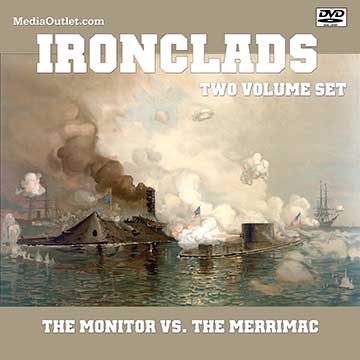
December 31, 1862: The American Civil War
(The Civil War, The War Between The States): Naval Warfare Of The
American Civil War (Naval Battles Of The American Civil War): The
Battle Of Hampton Roads (The Battle Of The Monitor And The
Merrimack, The Battle Of The Ironclads): -- The Union ironclad
ship USS Monitor sinks off Cape Hatteras during a storm, resulting
in the loss of sixteen crewmen. While the design of Monitor was
well-suited for river combat, her low freeboard and heavy turret
made her highly unseaworthy in rough waters. Under the command of
John P. Bankhead, Monitor put to sea on December 31 , under tow
from USS Rhode Island, as a heavy storm developed off Cape
Hatteras, North Carolina. Monitor was soon in trouble as the storm
increased in ferocity. Large waves were splashing over and
completely covering the deck and pilot house so the crew
temporarily rigged the wheel atop the turret which was manned by
helmsman Francis Butts.[Water continued flooding into the vents
and ports and the ship began rolling uncontrollably in the high
seas. Sometimes she would drop into a wave with such force the
entire hull would tremble. Leaks were beginning to appear
everywhere. Bankhead ordered the engineers to start the
Worthington pumps, which temporarily stemmed the rising waters,
but soon Monitor was hit by a squall and a series of violent waves
and water continued to work its way into the vessel. Right when
the Worthington pump could no longer keep pace with the flooding a
call came from the engine room that water was gaining there.
Realizing the ship was in serious trouble, Bankhead signaled Rhode
Island for help and hoisted the red lantern next to Monitor's
white running light atop the turret. He then ordered the anchor
dropped to stop the ship's rolling and pitching with little effect
making it no easier for the rescue boats to get close enough to
receive her crew. He then ordered the towline cut and called for
volunteers. Acting Master Stodder, along with crewmates John
Stocking, and James Fenwick volunteered and climbed down from the
turret, but eyewitnesses said that as soon as they were on the
deck Fenwick and Stocking were quickly swept overboard and
drowned. Stodder managed to hang onto the safety lines around the
deck and finally cut through the 13 inch towline with a hatchet.
At 11:30 p.m. Bankhead ordered the engineers to stop engines and
divert all available steam to the large Adams centrifugal steam
pump;[163] but with reduced steam output from a boiler being fed
wet coal it too was unable to stem the rapidly rising water. After
all steam pumps had failed, Bankhead ordered some of the crew to
man the hand pumps and organized a bucket brigade, but to no
avail. Officers Greene and Stodder were among the last men to
abandon ship and remained with Bankhead who was the last surviving
man to abandon the sinking Monitor. In his official report of
Monitor to the Navy Department, Bankhead praised Green and Stodder
for their heroic efforts and wrote, "I would beg leave to
call the attention of the Admiral and of the Department of the
particularly good conduct of Lieutenant Greene and Acting Master
Louis N. Stodder, who remained with me until the last, and by
their example did much toward inspiring confidence and obedience
on the part of the others." After a frantic rescue effort,
Monitor finally foundered and sank approximately 16 miles
southeast off Cape Hatteras with the loss of sixteen men,
including four officers, some of whom remained in the turret and
went down with the ironclad. Forty-seven men were rescued by the
life boats from Rhode Island. Bankhead, Green and Stodder barely
managed to get clear of the sinking vessel and survived the ordeal
but suffered from exposure from the icy winter sea. After his
initial recovery, Bankhead filed his official report, as did the
commanding officers of the Rhode Island, stating officers and men
of both Monitor and Rhode Island did everything within their
ability to keep Monitor from sinking. The Navy did not find it
necessary to commission a board of inquiry to investigate the
affair and took no action against Bankhead or any of his officers.
Some time later a controversy emerged over why Monitor sank. In
the Army and Navy Journal Ericsson accused the crew of drunkenness
during the storm, being consequently unable to prevent the vessel
from sinking. Stodder vigorously defended the crew and rebuked
Ericsson's characterization of the crew and events and wrote to
Pierce that Ericsson "covers up defects by blaming those that
are now dead", pointing out that there were a number of
unavoidable events and circumstances that led to the ship's
sinking, foremost being the overhang between the upper and lower
hulls which came loose and partially separated during the storm
from slamming into the violent waves. Stodder's account was
corroborated by other shipmates. On Sale @ 15% Off Discount Till
Midnight PT!
https://store.earthstation1.com/ironclads-monitor-vs-merrimac-dvd-us-civil-war-documentary.html
Today's
EarthStation1.com 15% Off Commemorative Memorial Title: Matisse,
Voyages: Henri Matisse Biography + Bonus DVD MP4 USB Drive
Today, December 31, 2025
December 31, 1869: #BOTD: #HBD! Henri
Matisse, French painter and sculptor (d. November 3, 1954) is
#born Henri Emile Benoit Matisse in Le Cateau-Cambresis, in the
Nord department in Northern France. Henri Matisse was an artist
known for both his use of colour and his fluid and original
draughtsmanship. He was a draughtsman, printmaker, and sculptor,
but is known primarily as a painter. Matisse is commonly regarded,
along with Pablo Picasso, as one of the artists who best helped to
define the revolutionary developments in the visual arts
throughout the opening decades of the twentieth century,
responsible for significant developments in painting and
sculpture. The intense colorism of the works he painted between
1900 and 1905 brought him notoriety as one of the Fauves (wild
beasts), early twentieth-century modern artists whose works
emphasized painterly qualities and strong color over the
representational or realistic values retained by Impressionism.
Many of his finest works were created in the decade or so after
1906, when he developed a rigorous style that emphasized flattened
forms and decorative pattern. In 1917 he relocated to a suburb of
Nice on the French Riviera, and the more relaxed style of his work
during the 1920s gained him critical acclaim as an upholder of the
classical tradition in French painting. After 1930, he adopted a
bolder simplification of form. When ill health in his final years
prevented him from painting, he created an important body of work
in the medium of cut paper collage. His mastery of the expressive
language of colour and drawing, displayed in a body of work
spanning over a half-century, won him recognition as a leading
figure in modern art. Henri Matisse died of a heart attack at the
age of 84 in Nice, France. He is interred in the cemetery of the
Monastere Notre Dame de Cimiez, in the Cimiez neighbourhood of
Nice. On Sale @ 15% Off Discount Till Midnight PT!
https://store.earthstation1.com/matisse-voyages-henri-matisse-biography-documentary.html
Today's
EarthStation1.com 15% Off Commemorative Memorial Title: The Birth
Of Europe: Ice Age To 20th Century DVD, Video Download, USB
Today, December 31, 2025
December 31, 1878: Great Inventions: The
Industrial Revolution: The Second Industrial Revolution
(1870s-1914): The Automobile: The History Of The Automobile: The
Automotive Industry: The History Of The Automotive Industry: --
Karl Benz, working in Mannheim, Germany, complete his invention of
the first reliable two-stroke engine, then applies for a patent
for it that same day, a patent which was granted in 1879. A
two-stroke (or two-cycle) engine is a type of internal combustion
engine which completes a power cycle with two strokes (up and down
movements) of the piston during only one crankshaft revolution.
Karl Friedrich Benz (25 November 1844: 4 April 1929) was a German
engine designer and automobile engineer. His Benz Patent Motorcar
from 1885 is considered the first practical automobile. He
received a patent for the motorcar on 29 January 1886. Karl Benz
led in the development of new engines in the early factory he and
his wife owned. To get more revenues, in 1878 he began to work on
new patents, beginning by concentrating all his efforts on
creating a reliable petrol two-stroke engine. #KarlBenz
#NewYearsEve #TwoStrokeEngine #Gasoline #Patents #MP4
#VideoDownload #DVD On Sale @ 15% Off Discount Till Midnight PT!
https://store.earthstation1.com/the-birth-of-europe-european-history-from-the-ice-age-to-20th-centu20.html
Today's
EarthStation1.com 15% Off Commemorative Memorial Title: Edison's
Miracle Of Light History Peter Coyote MP4 Video Download DVD
Today, December 31, 2025
December 31, 1879: Great Inventions: Lighting (Illumination): The History Of Lighting: Electric Light: The History Of Electric Light: Incandescent Lighting: The History Of Incandescent Lighting: -- Thomas Edison gives the first public demonstration of his electric incandescent lamp at his laboratory on Christie Street in Menlo Park, New Jersey, an event that the Pennsylvania Railroad Company ran special trains to (at the current location of MetroPark train station just below the end of Christie Street) in response to public enthusiasm over the event.. It was during this time that he said: "We will make electricity so cheap that only the rich will burn candles." Henry Villard, president of the Oregon Railroad and Navigation Company, attended Edison's 1879 demonstration. Villard was impressed and requested Edison install his electric lighting system aboard Villard's company's new steamer, the Columbia. Although hesitant at first, Edison agreed to Villard's request. Most of the work was completed in May 1880, and the Columbia went to New York City, where Edison and his personnel installed Columbia's new lighting system. The Columbia was Edison's first commercial application for his incandescent light bulb. Menlo Park is an unincorporated community located within Edison Township in Middlesex County, New Jersey, United States. In 1876, Thomas Edison set up his home and research laboratory in Menlo Park, which at the time was the site of an unsuccessful real estate development named after the town of Menlo Park, California. While there, he earned the nickname "the Wizard of Menlo Park". The Menlo Park lab was significant in that it was one of the first laboratories to pursue practical, commercial applications of research. It was in his Menlo Park laboratory that Thomas Edison invented the phonograph and developed a commercially viable incandescent light bulb filament. Christie Street in Menlo Park was one of the first streets in the world to use electric lights for illumination. Edison left Menlo Park and moved his home and laboratory to West Orange, New Jersey in 1887. After his death, the Thomas Alva Edison Memorial Tower and Museum was constructed near his old Menlo Park lab and dedicated in 1938. Edison's old lab site and memorial now make up Edison State Park. The municipality in which Menlo Park is located, which was called "Raritan Township" while he was alive, was officially changed to Edison Township on November 10, 1954, in honor of the inventor. On Sale @ 15% Off Discount Till Midnight PT! https://store.earthstation1.com/edmioflihipe.html
Today's
EarthStation1.com 15% Off Commemorative Memorial Title: General
George Marshall Documentaries Collection DVD, Download, USB
Today, December 31, 2025
December 31, 1880: #BOTD: #HBD! George
Marshall, American general, statesman and politician, 50th United
States Secretary Of State, Nobel Prize laureate (d. October 16,
1959) is #born George Catlett Marshall Jr. in Uniontown,
Pennsylvania. George Catlett Marshall Jr. was Chief Of Staff of
the United States Army under presidents Franklin D. Roosevelt and
Harry S. Truman, and served as Secretary Of State and Secretary Of
Defense under Truman. He was hailed as the "organizer of
victory" by Winston Churchill for his leadership of the
Allied victory in World War II. Marshall was a 1901 graduate of
the Virginia Military Institute. In the years after the
Spanish-American War, he served in the United States and overseas
in positions of increasing rank and responsibility, including
platoon leader and company commander in the Philippines during the
Philippine-American War. He was the Honor Graduate of his
Infantry-Cavalry School Course in 1907, and graduated first in his
1908 Army Staff College class. After the United States entered
World War I, Marshall served as aide-de-camp with General J.
Franklin Bell, the commander of the Western Department, while Bell
commanded the Department of the East. Subsequently assigned to the
staff of the American Expeditionary Forces headquarters, he was a
key planner of American operations including the Meuse-Argonne
Offensive. After the war, Marshall was assigned as an aide-de-camp
to John J. Pershing, who was then serving as the Army's Chief Of
Staff. He later served on the Army staff, commanded the 15th
Infantry Regiment in China, and was an instructor at the Army War
College. In 1927, he became assistant commandant of the Army's
Infantry School, where he modernized command and staff processes,
which proved to be of major benefit during World War II. In 1932
and 1933 he commanded the 8th Infantry Regiment and Fort Screven,
Georgia. Marshall commanded 5th Brigade, 3rd Infantry Division and
Vancouver Barracks from 1936 to 1938, and received promotion to
brigadier general. During this command, Marshall was also
responsible for 35 Civilian Conservation Corps (CCC) camps in
Oregon and southern Washington. In July 1938, Marshall was
assigned to the War Plans Division on the War Department staff,
and he was subsequently appointed as the Army's Deputy Chief Of
Staff. When Chief Of Staff Malin Craig retired in 1939, Marshall
became acting Chief Of Staff, and then Chief Of Staff. He served
as Chief Of Staff until the end of the war in 1945. As Chief Of
Staff, Marshall organized the largest military expansion in U.S.
history, expanding the Army from 130,000 to 8,300,000 men, and
received promotion to five-star rank as General of the Army.
Marshall coordinated Allied operations in Europe and the Pacific
until the end of the war; in addition to being hailed as the
organizer of Allied victory by Winston Churchill, Time magazine
named Marshall its Man of the Year for 1943. Marshall retired from
active service in 1945, but remained on active duty, a requirement
for holders of five-star rank. In late 1945 and early 1946 he
served as a special envoy to China in an unsuccessful effort to
negotiate a coalition government between the Nationalists of
Chiang Kai-shek and Communists under Mao Zedong. As Secretary Of
State from 1947 to 1949, Marshall received credit for the Marshall
Plan for Europe's post-war rebuilding, the success of which was
recognized with award of the 1953 Nobel Peace Prize. After
resigning as Secretary Of State, Marshall served as chairman of
American Battle Monuments Commission and president of the American
National Red Cross. As Secretary Of Defense at the start of the
Korean War, Marshall worked to restore the military's confidence
and morale at the end of its post-World War II demobilization and
then its initial buildup for combat in Korea and operations during
the Cold War. After resigning as Defense Secretary, Marshall
retired to his home in Virginia until his passing. George Marshall
died after a series of strokes at Walter Reed Hospital in
Washington, D.C., aged 78. He is buried at Arlington National
Cemetery. On Sale @ 15% Off Discount Till Midnight PT!
https://store.earthstation1.com/general-george-marshall-documentaries-dvd.html
Today's
EarthStation1.com 15% Off Commemorative Memorial Title: Murderers
Among Us: The Simon Wiesenthal Story DVD, MP4 Download, USB
Today, December 31, 2025
December 31, 1908: #BOTD: #HBD! Simon
Wiesenthal, Jewish Austrian Holocaust survivor, Nazi hunter and
writer (d. September 20, 2005) is #born in Buczacz (Buchach),
Kingdom of Galicia and Lodomeria, then part of Austria-Hungary,
now Ternopil Oblast, in Ukraine. Simon Wiesenthal KBE studied
architecture and was living in Lwow at the outbreak of World War
II. He survived the Janowska concentration camp (late 1941 to
September 1944), the Krakow-Plaszow concentration camp (September
to October 1944), the Gross-Rosen concentration camp, a death
march to Chemnitz, Buchenwald, and the Mauthausen-Gusen
concentration camp (February to 5 May 1945). After the war,
Wiesenthal dedicated his life to tracking down and gathering
information on fugitive Nazi war criminals so that they could be
brought to trial. In 1947, he co-founded the Jewish Historical
Documentation Centre in Linz, Austria, where he and others
gathered information for future war crime trials and aided
refugees in their search for lost relatives. He opened the
Documentation Centre of the Association of Jewish Victims of the
Nazi Regime in Vienna in 1961 and continued to try to locate
missing Nazi war criminals. He played a small role in locating
Adolf Eichmann, who was captured in Buenos Aires in 1960, and
worked closely with the Austrian justice ministry to prepare a
dossier on Franz Stangl, who was sentenced to life imprisonment in
1971. In the 1970s and 1980s, Wiesenthal was involved in two
high-profile events involving Austrian politicians. Shortly after
Bruno Kreisky was inaugurated as Austrian chancellor in April
1970, Wiesenthal pointed out to the press that four of his new
cabinet appointees had been members of the Nazi Party. Kreisky,
angry, called Wiesenthal a "Jewish fascist", likened his
organisation to the Mafia, and accused him of collaborating with
the Nazis. Wiesenthal successfully sued for libel, the suit ending
in 1989. In 1986, Wiesenthal was involved in the case of Kurt
Waldheim, whose service in the Wehrmacht and probable knowledge of
the Holocaust were revealed in the lead-up to the 1986 Austrian
presidential elections. Wiesenthal, embarrassed that he had
previously cleared Waldheim of any wrongdoing, suffered much
negative publicity as a result of this event. With a reputation as
a storyteller, Wiesenthal was the author of several memoirs
containing tales that are only loosely based on actual events. In
particular, he exaggerated his role in the capture of Eichmann in
1960. Wiesenthal died in his sleep at age 96 in Vienna, Austria.
He is buried in the city of Herzliya in Israel. The Simon
Wiesenthal Center, headquartered in Los Angeles, is named in his
honor. On Sale @ 15% Off Discount Till Midnight PT!
https://store.earthstation1.com/murderers-among-us-the-simon-wiesenthal-story-dvd-2-disc-se2.html
Today's
EarthStation1.com 15% Off Commemorative Memorial Title: BBC
Engineering Society Early Days Of Broadcasting CD MP3 Download USB
Today, December 31, 2025
December 31, 1926: The History Of
Broadcasting: The History Of Radio Broadcasting: The History Of
British Broadcasting: The History Of British Radio Broadcasting:
-- The British Broadcasting Company (the orginal BBC) is
dissolved, and its assets are transferred to the non-commercial
and crown-chartered British Broadcasting Corporation (the current
and permanent BBC). On October 18, 1922, The British Broadcasting
Company (later Corporation) is founded by a consortium, to
establish a nationwide network of radio transmitters to provide a
national broadcasting service. The British Broadcasting Company,
Ltd. (BBC) was a British commercial company formed by British and
American electrical companies doing business in the United
Kingdom. Licensed by the British General Post Office, their
original office was located on the second floor of Magnet House,
the GEC buildings in London and consisted of a room and a small
antechamber. On December 14, 1922, John Reith was hired to become
the Managing Director of the company at that address. The company
later moved its offices to the premises of the Marconi Company.
The BBC as a commercial broadcasting company did not sell air time
but it did carry a number of sponsored programmes paid for by
British newspapers. On Sale @ 15% Off Discount Till Midnight PT!
https://store.earthstation1.com/bbc-engineering-society-the-early-days-of-broadcasting-mp3-c3.html
Today's
EarthStation1.com 15% Off Commemorative Memorial Title: Eyes On
The Prize II: America At The Racial Crossroads DVD MP4 USB
Today, December 31, 2025
December 31, 1930: #BOTD: #HBD! Odetta,
African American singer, songwriter, guitarist, actress and civil
rights activist, often referred to as "The Voice of the Civil
Rights Movement" (d. December 2, 2008) is #born Odetta Holmes
in Birmingham, Alabama. Her musical repertoire consisted largely
of American folk music, blues, jazz, and spirituals. An important
figure in the American folk music revival of the 1950s and 1960s,
she influenced many of the key figures of the folk-revival of that
time, including Bob Dylan, Joan Baez, Mavis Staples, and Janis
Joplin. Time magazine included her recording of "Take This
Hammer" on its list of the 100 Greatest Popular Songs,
stating that "Rosa Parks was her No. 1 fan, and Martin Luther
King Jr. called her the queen of American folk music." Odetta
died of heart disease in New York City on December 2, 2008, trying
hard to hold on to life long enough to perform at Barack Obama's
inauguration on January 20, 2009. Her remains were cremated, and
her ashes were scattered upon the Harlem Meer, a man-made lake at
the northeast corner of New York City's Central Park, at 108th
Street and Fifth Avenues. On Sale @ 15% Off Discount Till Midnight
PT!
https://store.earthstation1.com/eyes-on-the-prize-ii-dvd-set-4-discs-complete-2nd-seri42.html
Today's
EarthStation1.com 15% Off Commemorative Memorial Title: Rowan &
Martin's Laugh-In MegaSet 2 Albums 2 Blooper Sets MP3 MP4 DVD
Today, December 31, 2025
December 31, 1932: #BOTD: #HBD! George
Schlatter, American television producer, director and creative
genius, best known for creating and producing the pioneering
comedy television show Rowan & Martin's Laugh-In, founder of
the American Comedy Awards, is #born in Birmingham, Alabama, the
son of a violinist mother and a salesman father. Between 1968 and
1996, Schlatter was nominated for 15 Emmy Awards, winning twice
for Rowan & Martin's Laugh-In as Outstanding Musical or
Variety Program (1968) and for Sammy Davis, Jr. 60th Anniversary
Celebration as Outstanding Variety, Music or Comedy Special
(1990). He was also nominated for a Writers Guild of America award
in 1997. For his work on television, Schlatter has a star on the
Hollywood Walk of Fame at 7030 Hollywood Blvd. He was raised in
Webster Groves, Missouri, a St. Louis inner-ring suburb. As a
teenager, Schlatter sang for two seasons with the St. Louis
Municipal Opera, where his mother also performed. He attended
Pepperdine University in Los Angeles, California. Schlatter was a
Hollywood agent in the band and act department of MCA Records.
After several years, he left to become general manager at the
Sunset Strip nightclub Ciro's. The comedy team of Dan Rowan and
Dick Martin performed there. In the early 1960s, following a short
stint in Las Vegas, he started producing variety series and
specials for television. Between 1964 and 1970, he oversaw the
annual telecast of the Grammy Awards. In 1968, he formed George
Schlatter Productions, noted for Rowan and Martin's Laugh In on
NBC. In the 1970s and 1980s, Schlatter produced and directed
several television series, while continuing to produce variety
specials. In 1987, he started "The American Comedy Awards",
which was an annual event through 2001. Schlatter also produced a
few feature films, and owns The Editing Company, which for many
years was one of Hollywood's busiest state-of-the-art post
production facilities. He is married to former actress and beauty
Jolene Brand, who was a regular on several Ernie Kovacs shows of
the early 1960s. They have two daughters, Andrea and Maria. Andrea
Justine is a champion equestrian rider. Maria S. Schlatter is an
Emmy award winning television producer. On Sale @ 15% Off Discount
Till Midnight PT!
https://store.earthstation1.com/rowan-and-martin-discount-set-2-albums-2-blooper-reel-sets-mp3-mp4-dvd.html
Today's
EarthStation1.com 15% Off Commemorative Memorial Title: Blunt: The
Fourth Man (1985) DVD, Video Download, USB Flash Drive
Today, December 31, 2025
December 31, 1937: #BOTD: #HBD! Anthony
Hopkins, Welsh actor, film director, film producer, composer and
painter is #born Philip Anthony Hopkins in Margam, a suburb of
Port Talbot, Glamorgan, Wales. His parents were Annie Muriel (nee
Yeates) and Richard Arthur Hopkins, a baker. He stated his
father's working-class values have always underscored his life,
"Whenever I get a feeling that I may be special or different,
I think of my father and I remember his hands - his hardened,
broken hands." Sir Philip Anthony Hopkins CBE is the
recipient of multiple accolades, including an Academy Award, three
BAFTAs, two Emmys and the Cecil B. DeMille Award. In 1993, he was
knighted by Queen Elizabeth II for services to the arts. Hopkins
received a star on the Hollywood Walk of Fame in 2003, and in 2008
he received the BAFTA Fellowship for lifetime achievement from the
British Academy of Film and Television Arts. After graduating from
the Royal Welsh College of Music & Drama in 1957, he trained
at the Royal Academy of Dramatic Art in London, and was then
spotted by Laurence Olivier who invited him to join the Royal
National Theatre in 1965. Productions at the National included
King Lear, his favourite Shakespeare play. His last stage play was
a West End production of M. Butterfly in 1989. In 1968, Hopkins
achieved recognition in film, playing Richard the Lionheart in The
Lion in Winter. In the mid-1970s, Richard Attenborough, who would
direct five Hopkins films, called him "the greatest actor of
his generation." In 1991, he portrayed Hannibal Lecter in The
Silence of the Lambs, winning the Academy Award for Best Actor. He
reprised the role in its sequel Hannibal and the prequel Red
Dragon. Other notable films include: The Elephant Man (1980), 84
Charing Cross Road (1987), Howards End (1992), Bram Stoker's
Dracula (1992), Shadowlands (1993), Legends of the Fall (1994),
Meet Joe Black (1998), The Mask of Zorro (1998), as well as Thor
(2011) and its 2013 and 2017 sequels. Hopkins has since been
nominated for four other Academy Awards for the films The Remains
of the Day (1993), Nixon (1995), Amistad (1997) and The Two Popes
(2019). In 2020, Hopkins starred in The Father alongside Olivia
Colman. Since making his small screen debut with the BBC in 1967,
Hopkins has continued to appear on television. In 2015, he starred
in the BBC television film The Dresser alongside Ian McKellen, and
In 2018, he starred in King Lear opposite Emma Thompson. In 2016
and 2018, he starred in the HBO television series Westworld for
which he received a Primetime Emmy Award nomination. On Sale @ 15%
Off Discount Till Midnight PT!
https://store.earthstation1.com/blunt-the-fourth-man-dvd-anthony-hopkins-ian-richardson.html
Today's
EarthStation1.com 15% Off Commemorative Memorial Title: WABC Radio
Airchecks MP3 Collection 1960s-1980s DVD, MP3 Download, USB
Today, December 31, 2025
December 31, 1943: #BOTD: #HBD! John
Denver, American country and folk singer, songwriter and
guitarist, and actor (d. October 12, 1997) is #born Henry John
Deutschendorf Jr. in Roswell, New Mexico, to Erma Louise (nee
Swope; 1922-2010) and Captain Henry John "Dutch"
Deutschendorf Sr. (1920-1982), a United States Army Air Forces
pilot stationed at Roswell Army Air Field. Captain Deutschendorf
Sr. was a decorated pilot who set a number of air speed records in
a Convair B-58 Hustler in 1961. In his 1994 autobiography Take Me
Home, Denver described his father as a stern man who could not
show his love for his children. With a military father, Denver's
family moved often, and he found difficulty making friends and
assimilating with children of his own age. The introverted Denver
often felt out of place and did not know where he truly belonged.
While stationed at Davis-Monthan Air Force Base in Tucson,
Arizona, the Deutschendorfs purchased a house and lived there from
1951 to 1959. Denver lived in Tucson from ages six to 14. During
these years, Denver attended Mansfeld Junior High School and was a
member of the Tucson Arizona Boys Chorus for two years. He was
content in Tucson, but his father was transferred to Maxwell Air
Force Base in Montgomery, Alabama. The family later moved to
Carswell Air Force Base in Fort Worth, Texas, where Denver
graduated from Arlington Heights High School. Denver was
distressed with life in Fort Worth, and in his junior year of high
school he drove his father's car to California to visit family
friends and begin his music career. His father flew to California
in a friend's jet to retrieve him, and Denver reluctantly returned
to Texas to complete his schooling. At age 11, Denver received an
acoustic guitar from his grandmother. He learned to play well
enough to perform at local clubs by the time he was in college.
Denver decided to change his name when Randy Sparks, founder of
the New Christy Minstrels, suggested that "Deutschendorf"
would not fit comfortably on a marquee. Denver attended Texas Tech
University in Lubbock and sang in a folk-music group, "The
Alpine Trio", while studying architecture. He was also a
member of the Delta Tau Delta fraternity. Denver dropped out of
Texas Tech in 1963 and moved to Los Angeles, where he sang in folk
clubs. In 1965, Denver joined The Chad Mitchell Trio, replacing
founder Chad Mitchell. After more personnel changes, the trio
later became known as "Denver, Boise, and Johnson" (John
Denver, David Boise, and Michael Johnson), with whom he appeared
at the Philadelphia Folk Festival in 1968, then alone in 1969 and
1970. In 1969, Denver abandoned band life to pursue a solo career
and released his first album for RCA Records, Rhymes &
Reasons. Two years earlier, he had made a self-produced demo
recording of some of the songs he played at his concerts. It
included a song Denver had written called "Babe, I Hate to
Go", later renamed "Leaving on a Jet Plane". He
made several copies and gave them out as Christmas presents. Milt
Okun, who produced records for The Chad Mitchell Trio and folk
group Peter, Paul and Mary, had become Denver's producer as well.
Okun brought the unreleased "Jet Plane" song to Peter,
Paul and Mary. Their rendition hit number one on the Billboard Hot
100. Denver's song also made it to No. 2 in the UK in February
1970, having also made No. 1 on the US Cash Box chart in December
1969. RCA did not actively promote Rhymes & Reasons with a
series of live appearances, but Denver embarked on an impromptu
supporting tour throughout the Midwest, stopping at towns and
cities, offering to play free concerts at local venues. When he
was successful in persuading a school, college, American Legion
hall, or coffeehouse to let him perform, Denver distributed
posters in the town and usually showed up at the local radio
station, guitar in hand, offering himself for an interview. As the
writer of "Leaving on a Jet Plane", Denver was often
successful in gaining some promotional airtime, usually performing
one or two songs live. Some venues let him play for the 'door';
others restricted him to selling copies of the album at
intermission and after the show. After several months of this,
Denver had built a solid fan base, many of whom remained loyal
throughout his career. Denver recorded two more albums in 1970,
Take Me to Tomorrow and Whose Garden Was This, including a mix of
songs he had written and covers of other writers' compositions.
Denver's next album, Poems, Prayers & Promises (1971), was a
breakthrough for him in the United States, thanks in part to the
single "Take Me Home, Country Roads", which went to No.
2 on the Billboard charts despite the first pressings of the track
being distorted. Its success was due in part to the efforts of his
new manager, future Hollywood producer Jerry Weintraub, who signed
Denver in 1970. Weintraub insisted on a reissue of the track and
began a radio airplay campaign that started in Denver, Colorado.
Denver's career flourished thereafter, and he had a series of hits
over the next four years. In 1972, Denver had his first Top Ten
album with Rocky Mountain High, with its title track reaching the
Top Ten in 1973. In 1974 and 1975, Denver had a string of four No.
1 songs ("Sunshine on My Shoulders", "Annie's
Song", "Thank God I'm a Country Boy", and "I'm
Sorry") and three No. 1 albums (John Denver's Greatest Hits,
Back Home Again, and Windsong). In the 1970s, Denver's onstage
appearance included long blond hair and wire-rimmed "granny"
glasses. His embroidered shirts with images commonly associated
with the American West were created by the designer and applique
artist Anna Zapp. Weintraub insisted on a significant number of
television appearances, including a series of half-hour shows in
the United Kingdom, despite Denver's protests at the time, "I've
had no success in Britain ... I mean none". In December 1976,
Weintraub told Maureen Orth of Newsweek: "I knew the critics
would never go for John. I had to get him to the people."
After appearing as a guest on many shows, Denver hosted his own
variety and music specials, including several concerts from Red
Rocks Amphitheatre. His seasonal special Rocky Mountain Christmas
was watched by more than 60 million people and was the
highest-rated show for the ABC network at that time. In 1973,
Denver starred in his own BBC television series, The John Denver
Show, a weekly music and variety show directed and produced by
Stanley Dorfman. Denver's live concert special An Evening with
John Denver won the 1974-1975 Emmy Award for Outstanding Special,
Comedy-Variety or Music. When Denver ended his business
relationship in 1982 because of Weintraub's focus on other
projects, Weintraub threw Denver out of his office and accused him
of Nazism. Denver later told Arthur Tobier when the latter edited
his autobiography, "I'd bend my principles to support
something he wanted of me. And of course, every time you bend your
principles - whether because you don't want to worry about it, or
because you're afraid to stand up for fear of what you might lose
- you sell your soul to the devil." Denver was also a guest
star on The Muppet Show, the beginning of the lifelong friendship
between Denver and Jim Henson that spawned two television specials
with the Muppets, A Christmas Together and Rocky Mountain Holiday.
He also tried acting, appearing in "The Camerons are a
Special Clan" episode of the Owen Marshall, Counselor at Law
television series in October 1973 and "The Colorado Cattle
Caper" episode of the McCloud television series in February
1974. In 1977, Denver starred in the hit comedy film Oh, God!
opposite George Burns. He also hosted the Grammy Awards five times
in the 1970s and 1980s and guest-hosted The Tonight Show on
several occasions. In 1975, Denver was awarded the Country Music
Association's Entertainer of the Year award. At the ceremony,
outgoing Entertainer of the Year Charlie Rich presented the award
to his successor after he set fire to the slip of paper containing
the official notification of the award. Some speculated Rich was
protesting the selection of a non-traditional country artist for
the award, but Rich's son disputes that, saying his father was
drunk, taking pain medication for a broken foot and just trying to
be funny. Denver's music was defended by country singer Kathy
Mattea, who told Alanna Nash of Entertainment Weekly "A lot
of people write him off as lightweight, but he articulated a kind
of optimism, and he brought acoustic music to the forefront,
bridging folk, pop, and country in a fresh way ... People forget
how huge he was worldwide." In 1977, Denver co-founded The
Hunger Project with Werner Erhard and Robert W. Fuller. He served
for many years and supported the organization until his death.
President Jimmy Carter appointed Denver to serve on the
President's Commission on World Hunger. Denver wrote the song "I
Want to Live" as the commission's theme song. In 1979, Denver
performed "Rhymes & Reasons" at the Music for UNICEF
Concert. Royalties from the concert performances were donated to
UNICEF. Denver's father taught him how to fly in the mid-1970s,
which led to their reconciliation. In 1980, Denver and his father
co-hosted an award-winning television special, The Higher We Fly:
The History of Flight. It won the Osborn Award from the
Aviation/Space Writers' Association and was honored by the Houston
Film Festival. In the mid-1970s, Denver became outspoken in
politics. He expressed his ecological interests in the 1975 song
"Calypso", an ode to the eponymous exploration ship RV
Calypso used by Jacques Cousteau. Denver was a supporter of the
Democratic Party and of a number of charitable causes for the
environmental movement, the homeless, the poor, the hungry, and
the African AIDS crisis. He founded the charitable Windstar
Foundation in 1976 to promote sustainable living. Denver's dismay
at the Chernobyl disaster led to precedent-setting concerts in
parts of communist Asia and Europe. During the 1980s, Denver was
critical of Ronald Reagan's administration and remained active in
his campaign against hunger, for which Reagan awarded Denver the
Presidential World Without Hunger Award in 1987. Denver's
criticism of the conservative politics of the 1980s was expressed
in his autobiographical folk-rock ballad "Let Us Begin (What
Are We Making Weapons For?)". In an open letter to the media,
Denver wrote that he opposed oil drilling in the Arctic National
Wildlife Refuge. He had battled to expand the refuge in the 1980s,
and he praised President Bill Clinton for his opposition to the
proposed drilling. The letter, which Denver wrote in the midst of
the 1996 United States presidential election, was one of the last
he ever wrote. In 1992, Denver and fellow singers Liza Minnelli
and John Oates performed a benefit to fight the passage of
Colorado Amendment 2, an anti-gay ballot measure approved by
voters that prevented Colorado municipalities from enacting
anti-discrimination protections. Denver was also on the National
Space Society's board of governors for many years. Denver's
releases in the late 1970s did not match his earlier success. His
songwriting had begun to focus more on humanitarian and
sustainability causes than on the romantic themes of his earlier
writing. Denver also founded the environmental group Plant-It
2020. His keen interest in solutions to world hunger led him to
visit Africa during the 1980s and to witness firsthand the
suffering caused by starvation. From 1973 to 1979, Denver
performed annually at the fundraising picnic for the Aspen Camp
School for the Deaf, raising half of the camp's annual operating
budget. During the Aspen Valley Hospital's 1.7M USD capital
campaign in 1979, Denver was the largest single donor. In 1983 and
1984, Denver hosted the annual Grammy Awards, as he had previously
done in 1977, 1978, and 1979. In the 1983 finale, he was joined on
stage by folk music legend Joan Baez, with whom Denver led group
rendition of "Blowin' in the Wind" and "Let the
Sunshine In", joined by a number of other prominent
performers like Jennifer Warnes, Donna Summer, and Rick James. In
1984, ABC Sports president Roone Arledge asked Denver to compose
and sing the theme song for the 1984 Winter Olympics in Sarajevo.
Denver complied by writing and singing "The Gold and Beyond".
In 1985, Denver asked to participate in the singing of "We
Are the World" but was rejected despite his previous
commitment to charity work. According to producer Ken Kragen,
Denver was overlooked because some industry professionals felt his
image would hurt the credibility of the song as a pop-rock anthem.
"I didn't agree with this assessment," Kragen said, but
he reluctantly turned Denver down anyway. Denver later wrote in
his 1994 autobiography "Take Me Home" that the rejection
"...broke my heart not to be included." Nonetheless, for
Earth Day 1990, Denver was the on-camera narrator of the
television program In Partnership With Earth with then-EPA
Administrator William K. Reilly. Denver's love of flying attracted
him to NASA, and he became dedicated to the United States' work in
outer space. Denver worked to help bring into being the "Citizens
in Space" program and in 1985 received the NASA Exceptional
Public Service Medal for "helping to increase awareness of
space exploration by the peoples of the world." That same
year, he passed NASA's physical exam and was a finalist for the
first citizen's trip on the Space Shuttle in 1986. After the Space
Shuttle Challenger disaster with teacher Christa McAuliffe aboard,
Denver dedicated his song "Flying for Me" to all
astronauts and continued to support NASA. He entered discussions
with the Soviet space program about purchasing a flight aboard one
of their rockets, but the talks fell through after the price tag
was rumored to be as high as 20M USD. Denver testified before the
Senate Labor and Commerce Committee on the topic of censorship
during a Parents Music Resource Center hearing in 1985. Denver
openly stood with controversial witnesses like Dee Snider of the
heavy metal band Twisted Sister and Frank Zappa in opposing the
PMRC's objectives. Denver also toured Russia in 1985. His eleven
concerts in the USSR were the first by any American artist in more
than 10 years. Denver returned two years later to perform at a
benefit concert for the victims of the Chernobyl disaster. In
October 1992, Denver undertook a multiple-city tour of the
People's Republic of China. He also released a greatest-hits CD
named Homegrown to raise money for homeless charities. In 1994, he
published his autobiography Take Me Home in which he candidly
spoke of his drug use, his marital infidelities, and his history
of domestic violence. In 1997, Denver filmed an episode for the
television series Nature centering on the natural wonders that
inspired many of his best-loved songs. His last song,
"Yellowstone, Coming Home", composed while rafting along
the Colorado River with his son and young daughter, is included.
In the summer of 1997 shortly before his death, Denver recorded a
children's train album for Sony Pictures Kids Zone, All Aboard!,
produced by longtime friend Roger Nichols. The album consisted of
old-fashioned swing, big band, folk, bluegrass, and gospel music
woven into a theme of railroad songs. It won a posthumous Best
Musical Album for Children Grammy, Denver's only Grammy. In 1996,
Denver was inducted into the Songwriters Hall of Fame. His final
concert was held in Corpus Christi, Texas, at the Selena
Auditorium on October 5, 1997. Denver's first marriage, in 1967,
was to Annie Martell of St. Peter, Minnesota. She was the subject
of his song "Annie's Song", which he composed in 10
minutes as he sat on a Colorado ski lift. They lived in Edina,
Minnesota, from 1968 to 1971. After the success of "Rocky
Mountain High", inspired by a camping trip with Annie and
some friends, Denver bought a residence in Aspen, Colorado. He
lived in Aspen until his death. The Denvers adopted a boy, Zachary
John, and a girl, Anna Kate, who Denver said were "meant to
be" theirs. Denver once said, "I'll tell you the best
thing about me. I'm some guy's dad; I'm some little gal's dad.
When I die, Zachary John and Anna Kate's father, boy, that's
enough for me to be remembered by. That's more than enough."
Zachary was the subject of "A Baby Just Like You", a
song that included the line "Merry Christmas, little Zachary"
which he wrote for Frank Sinatra. Denver and Martell divorced in
1982. In a 1983 interview shown in the documentary John Denver:
Country Boy (2013), Denver said that career demands drove them
apart. Martell said they were too young and immature to deal with
Denver's sudden success. To drive home the point that their assets
were being split in the divorce, he cut their marital bed in half
with a chainsaw. Denver married Australian actress Cassandra
Delaney in 1988 after a two-year courtship. Settling at Denver's
home in Aspen, the couple had a daughter, Jesse Belle. Denver and
Delaney separated in 1991 and divorced in 1993. Of his second
marriage, Denver said that "before our short-lived marriage
ended in divorce, she managed to make a fool of me from one end of
the valley to the other." In 1993, Denver pleaded guilty to a
drunken driving charge and was placed on probation. In August 1994
while still on probation, he was again charged with misdemeanor
driving under the influence after crashing his Porsche into a tree
in Aspen. In October 1995, following Denver's drunk-driving
conviction, the Federal Aviation Administration (FAA) directed
Denver to abstain from alcohol if he wished to continue flying
airplanes. In 1996, the (FAA) determined that Denver was medically
disqualified from operating an aircraft due to his failure to
abstain from alcohol. Although a July 1997 trial resulted in a
hung jury on the second DUI charge, prosecutors later decided to
reopen the case, which was closed only after Denver died in
October 1997. Beyond music, Denver's artistic interests included
painting, but because of his limiting schedule, Denver pursued
photography, saying once, "photography is a way to
communicate a feeling." An exhibition of over 40
never-before-seen photographs taken by Denver debuted at the Leon
Gallery in Denver, Colorado, in 2014. Denver was also an avid
skier and golfer, but his principal interest was in flying.
Denver's love of flying was second only to his love of music. In
1974, Denver bought a Learjet to fly himself to concerts. He was a
collector of vintage biplanes and owned a Christen Eagle aerobatic
plane, two Cessna 210 Centurion airplanes, and a 1997
amateur-built Rutan Long-EZ. On April 21, 1989, Denver was in a
plane accident while taxiing down the runway at Holbrook Municipal
Airport near Holbrook, Arizona in his vintage 1931 biplane. Denver
had stopped to refuel on a flight from Carefree, Arizona, to Santa
Fe, New Mexico. Reports stated wind gusts caught the plane,
causing it to spin around and sustain extensive damage. Denver was
not harmed in the incident. John Denver died when his light
homebuilt Rutan Long-EZ aircraft crashed into Monterey Bay near
Pacific Grove, California, while making a series of solo
touch-and-go landings at the nearby Monterey Peninsula Airport. He
was the plane's only occupant. Denver was an experienced pilot
with more than 2,700 hours of experience. He had recently
purchased the Long-EZ aircraft, made by someone else from a kit,
and had taken a half-hour checkout flight with the aircraft the
day before the crash. Denver was not legally permitted to fly at
the time of the crash because of his previous arrests for driving
under the influence of alcohol.[67] In 1996, nearly a year before
the crash, the FAA learned that Denver had failed to maintain
sobriety by not refraining entirely from alcohol and revoked his
medical certification. However, it was determined that the crash
was not caused or influenced by alcohol use; an autopsy found no
signs of alcohol or other drugs in Denver's body. The post-crash
investigation by the National Transportation Safety Board (NTSB)
showed that the leading cause of the crash was Denver's inability
to switch fuel tanks during flight. The quantity of fuel had been
depleted during the plane's flight to Monterey and in several
brief practice takeoffs and landings Denver performed at the
airport immediately before the final flight. His newly purchased
amateur-built Rutan aircraft had an unusual fuel tank selector
valve handle configuration. The handle had originally been
intended by the plane's designer to be between the pilot's legs.
The builder instead put it behind the pilot's left shoulder. The
fuel gauge was also placed behind the pilot's seat and was not
visible to the person at the controls. An NTSB interview with the
aircraft mechanic servicing Denver's plane revealed that he and
Denver had discussed the inaccessibility of the cockpit fuel
selector valve handle and its resistance to being turned. Upon the
announcement of Denver's death, Colorado Governor Roy Romer
ordered all state flags to be lowered to half-staff in his honor.
Funeral services were held at Faith Presbyterian Church in Aurora,
Colorado, on October 17, 1997, officiated by Pastor Les Felker, a
retired Air Force chaplain, after which Denver's remains were
cremated and his ashes scattered in the Rocky Mountains. Further
tributes were made at the following Grammy and Country Music
Association Awards. On Sale @ 15% Off Discount Till Midnight PT!
https://store.earthstation1.com/wabc-musicradio-shows-mp3-dvd-60s80s-am-360807775.html
Today's
EarthStation1.com 15% Off Commemorative Memorial Title: DJ
Madness! 1950s-60s-70s Radio Shows DVD, MP3 Download, USB Drive
Today, December 31, 2025
#OTD #TDIH #December31, 1948: #BOTD:
#HBD! Donna Summer, African American singer, songwriter, actress
and beauty (d. May 17, 2012) is #born LaDonna Adrian Gaines in
Boston, Massachusetts. Widely known by her stage name based on her
married name Donna Summer, gained prominence during the disco era
of the late 1970s and became known as the "Queen of Disco",
while her music gained a global following. While influenced by the
counterculture of the 1960s, Summer became the lead singer of a
psychedelic rock band named Crow and moved to New York City.
Joining a touring version of the musical Hair, she left New York
and spent several years living, acting and singing in Europe,
where she met music producers Giorgio Moroder and Pete Bellotte in
Munich, where they recorded influential disco hits such as "Love
to Love You Baby" and "I Feel Love", marking her
breakthrough into an international career. Summer returned to the
United States in 1975, and other hits such as "Last Dance",
"MacArthur Park", "Heaven Knows", "Hot
Stuff", "Bad Girls", "Dim All the Lights",
"No More Tears (Enough Is Enough)" (duet with Barbra
Streisand) and "On the Radio" followed. Summer earned a
total of 42 hit singles on the US Billboard Hot 100 in her
lifetime, with 14 of those reaching the top-ten. She claimed a top
40 hit every year between 1975 and 1984, and from her first
top-ten hit in 1976, to the end of 1982, she had 12 top-ten hits
(10 were top-five hits), more than any other act during that time
period. She returned to the Hot 100's top-five in 1983, and
claimed her final top-ten hit in 1989 with "This Time I Know
It's for Real". She was the first artist to have three
consecutive double albums reach number one on the US Billboard 200
chart and charted four number-one singles in the US within a
12-month period. She also charted two number-one singles on the R
& B Singles chart in the US and a number-one single in the
United Kingdom. Her most recent Hot 100 hit came in 1999 with "I
Will Go with You (Con Te Partiro)". While her fortunes on the
Hot 100 waned through those decades, Summer remained a force on
the Billboard Dance Club Songs chart over her entire career.
Summer died of lung cancer at her home in Naples, Florida, aged
63. Being a nonsmoker, Summer theorized that her cancer had been
caused by inhaling toxic fumes and dust from the September 11
attacks in New York City; she was in her apartment near Ground
Zero when the attacks occurred. However, some reports have instead
attributed the cancer to Summer's smoking during her younger
years, her continued exposure to second-hand smoking while
performing in clubs well after she had quit, and a predisposition
to this disease in the family. Summer was survived by her husband,
Bruce Sudano, and her three daughters. Summer's funeral service
was held in Christ Presbyterian Church in Nashville, Tennessee, on
the afternoon of May 23, 2012. The exact location and time of the
service were kept private. Several hundred of Summer's friends and
relatives attended the funeral, according to CNN. The funeral was
a private ceremony, and cameras were not allowed inside the
church. She is interred in the Harpeth Hills Memory Gardens
cemetery in Nashville. She sold over 100 million records
worldwide, making her one of the best-selling music artists of all
time. She won five Grammy Awards. In her obituary in The Times,
she was described as the "undisputed queen of the Seventies
disco boom" who reached the status of "one of the
world's leading female singers." Giorgio Moroder described
Summer's work with them on the song "I Feel Love" as
"really the start of electronic dance" music. In 2013,
Summer was inducted into The Rock And Roll Hall Of Fame. In
December 2016, Billboard ranked her at No. 6 on its list of the
Greatest of All Time Top Dance Club Artists. On Sale @ 15% Off
Discount Till Midnight PT!
https://store.earthstation1.com/dj-radio-airchecks-mp3-dvd-1950s60s70s-dis319506070.html
Today's
EarthStation1.com 15% Off Commemorative Memorial Title: After The
War: The Marshall Plan + Bonus DVD MP4 Download USB Drive
Today, December 31, 2025
December 31, 1951: The Aftermath Of World
War II: The Marshall Plan (The European Recovery Program): -- The
Marshall Plan expires after successfully distributing more than
13.3B USD in foreign aid to rebuild Europe. The Marshall Plan was
signed on April 3, 1948 by President Harry S. Truman in order to
stop the spread of Communism and restore the economic life of
European countries devastated by World War II. Over four years,
the program distributed 12B USD to the nations of Western Europe.
The program was first proposed by Secretary Of State George C.
Marshall during a historic speech at Harvard University on June 5,
1947. The Marshall Plan (officially the European Recovery Program,
ERP) was an American initiative to aid Western Europe, in which
the United States gave over 13B USD (nearly 110B USD in 2016) in
economic assistance to help rebuild Western European economies
after the end of World War II. The plan was in operation for four
years beginning on April 3, 1948. The goals of the United States
were to rebuild war-torn regions, remove trade barriers, modernize
industry, improve European prosperity, and prevent the spread of
Communism. The Marshall Plan required a lessening of interstate
barriers, a dropping of many regulations, and encouraged an
increase in productivity, trade union membership, as well as the
adoption of modern business procedures. The Marshall Plan aid was
divided amongst the participant states roughly on a per capita
basis. A larger amount was given to the major industrial powers,
as the prevailing opinion was that their resuscitation was
essential for general European revival. Somewhat more aid per
capita was also directed towards the Allied nations, with less for
those that had been part of the Axis or remained neutral. The
largest recipient of Marshall Plan money was the United Kingdom
(receiving about 26% of the total), followed by France (18%) and
West Germany (11%). Some eighteen European countries received Plan
benefits. Although offered participation, the Soviet Union refused
Plan benefits, and also blocked benefits to Eastern Bloc
countries, such as Hungary and Poland. The United States provided
similar aid programs in Asia, but they were not part of the
Marshall Plan. However, its role in the rapid recovery has been
debated. Most reject the idea that it alone miraculously revived
Europe, since the evidence shows that a general recovery was
already under way. The Marshall Plan's accounting reflects that
aid accounted for less than 3% of the combined national income of
the recipient countries between 1948 and 1951, which means an
increase in GDP growth of only 0.3%. After World War II, in 1947,
industrialist Lewis H. Brown wrote at the request of General
Lucius D. Clay, A Report on Germany, which served as a detailed
recommendation for the reconstruction of post-war Germany, and
served as a basis for the Marshall Plan. The initiative was named
after United States Secretary Of State George Marshall. The plan
had bipartisan support in Washington, where the Republicans
controlled Congress and the Democrats controlled the White House
with Harry S. Truman as President. The Plan was largely the
creation of State Department officials, especially William L.
Clayton and George F. Kennan, with help from the Brookings
Institution, as requested by Senator Arthur H. Vandenberg,
chairman of the Senate Foreign Relations Committee. Marshall spoke
of an urgent need to help the European recovery in his address at
Harvard University in June 1947. The purpose of the Marshall Plan
was to aid in the economic recovery of nations after WWII and to
reduce the influence of Communist parties within them. To combat
the effects of the Marshall Plan, the USSR developed its own
economic plan, known as the Molotov Plan, in spite of the fact
that large amounts of resources from the Eastern Bloc countries to
the USSR were paid as reparations, for countries participating in
the Axis Power during the war. The phrase "equivalent of the
Marshall Plan" is often used to describe a proposed
large-scale economic rescue program. On Sale @ 15% Off Discount
Till Midnight PT!
https://store.earthstation1.com/after-the-war-the-marshall-plan-dvd.html
Today's
EarthStation1.com 15% Off Commemorative Memorial Title: Castro's
Cuba: Two Views/Guantanamo DVD, MP4 Download, USB Flash Drive
Today, December 31, 2025
December 31, 1958: The History Of Cuba:
The Cuban Revolution: The 26th of July Movement: The Flight Of
Fulgencio Batista: -- Cuban president Fulgencio Batista flees the
country in the aftermath of the victory of the revolution led by
Fidel Castro which established the present government in Cuba.
Fidel Castro becomes president the following day, commemorated in
Cuba every Jan. 1st thereafter as Triumph of the Revolution Day
(Spanish: Triunfo de la Revolucion), also known as Liberation Day
(Spanish: Dia de la Liberacion), and the first parade of the Cuban
Revolutionary Armed Forces took place that day on on the Plaza de
la Revolucion. The Cuban Revolution was an armed revolt conducted
by Fidel Castro's 26th of July Movement and its allies against the
authoritarian government of Cuban President Fulgencio Batista. The
revolution began in July 1953, and continued sporadically until
the rebels finally ousted Batista on January 1, 1959, replacing
his government with a revolutionary socialist state. The 26th of
July Movement later reformed along communist lines, becoming the
Communist Party in October 1965. The Cuban Revolution had powerful
domestic and international repercussions. In particular, it
transformed Cuba's relationship with the United States. In the
immediate aftermath of the revolution, Castro's government began a
program of nationalization and political consolidation that
transformed Cuba's economy and civil society. The revolution also
heralded an era of Cuban intervention in foreign military
conflicts, including the Angolan Civil War and the Nicaraguan
Revolution. On Sale @ 15% Off Discount Till Midnight PT!
https://store.earthstation1.com/castro39s-cuba-two-views-with-scott-simon-dvd-proandcon-fil39.html
Today's
EarthStation1.com 15% Off Commemorative Memorial Title: The
Stations Of Bach DVD, MP4 Video Download, USB Flash Drive
Today, December 31, 2025
December 31, 1968: The History Of
Broadcasting: The History Of Radio Broadcasting: Bachfest
(Bachfest WKCR, Bachfest New York City, Bachfest NYC): -- WKCR
ends its first broadcast of its annual Bachfest at the stroke of
midnight New Year's Eve, having run continuously, for 192 hours
non-stop, from the stroke of midnight Christmas Eve day, in the
celebration of the year's end. WKCR's Bach Festival is an 8-day
long pre-emption of the radio station's regular programming which
features only the music and genius of Johann Sebastian Bach,
lasting from Christmas Eve (12/24) through New Year's Eve (12/31).
Our EarthStation1.com/MediaOutlet.com proprietor J. C. Kaelin
says: "On Christmas Eve 1969, I got my very first radio - an
Admiral AM/FM/AFC, that smelled of burning wax when it was on for
a while because of the heat of the radio's transistors. The first
FM station I tuned it to that night - the very first FM station I
ever tuning into - was the world's first FM station, Columbia
University's WKCR ("King's Crown Radio", as the station
ID intoned). They were less than 24 hours into their second annual
Bachfest, and it was there that I heard a pipe organ for the first
time. I thought it was strange and wonderful, unlike anything I
had ever heard my father play on the car radio before (and he
played that radio a lot!). I was quite enchanted, and truly, I've
never been the same since - in the best possible way." So
tune in to WKCR-FM NY 89.9 or stream them at wkcr.org and listen
to a straight 192 hours of Bach and share! On Sale @ 15% Off
Discount Till Midnight PT!
https://store.earthstation1.com/the-stations-of-bach-dvd-johann-sebastion-bach-documentary.html
Today's
EarthStation1.com 15% Off Commemorative Memorial Title: Butt Out:
The Life & Death Of TV Cigarette Advertising DVD, MP4, USB
Today, December 31, 2025
December 31, 1970: Smoking: Cigerette
Smoking: Advertising: Television Advertising: Grand Finales:
Television Grand Finales: American Television Grand Finales: --
The last cigarette commercial airs in the United States at a few
minutes to midnight during Johnny Carson's Tonight Show, a
Virginia Slims ad ending with the words "Regular or King
size" spoken by Dan Ingram. On January 1, 1971, Cigarette
advertisements were banned on radio and TV in the U.S. due to
legislation signed into law on April 1st, 1970 (April Fool's Day)
by President Richard Nixon. The tobacco industry was a huge
advertising category, spending more than 150M USD on television
(1BM USD in 2019 dollars). The loss of that revenue was crippling
to the big three networks, and in order to make up for the lost
income, they introduced the 30-second commercial ("30s"),
which were less expensive to produce and buy than 60s. These
cheaper commercials attracted a whole new category - and revenue
pool - of smaller sponsors to network television. From this point
on, the 30-second commercial would become the standard of
advertising time. On Sale @ 15% Off Discount Till Midnight PT!
https://store.earthstation1.com/butt-out-life-amp-death-of-tv-cigarette-commercials-dvd-mp4-us4.html
Today's
EarthStation1.com #OnThisDay Commemorative Memorial Title: The
Dictators: The Rise Of Fascism DVD, Video Download, USB Drive
Today, December 31, 2025 December 31, 1924: The History Of Italy:
The History Of Fascist Italy:(Fascist Italy 1922-1943): -- Benito
Mussolini, who had pretended his regime was a democracy since he
became Prime Minister of Italy in 1922, meets with Blackshirt MVSN
consuls met with Mussolini and gave him an ultimatum: crush the
opposition or they would do so without him. Fearing a revolt by
his own militants, Mussolini decided to drop all pretense of
democracy, and on January 3, 1925, Mussolini began the process of
dismantling virtually all constitutional and conventional
restraints on his power with a belligerent speech before the
Italian Chamber of Deputies, the lower house of the bicameral
Parliament of Italy (the other being the Senate of the Republic).
In that speech, he took responsibility for all Blackshirt violence
committed in the past, though he did not mention the assassination
of the socialist deputy Giacomo Matteotti, who had requested in
the Italian Parliament that the results of the April 6, 1924
Italian General Election be annulled because the Fascists
committed fraud and used violence used to gain votes, and was
kidnapped and killed by Fascists eleven days later for saying so,
provoked a momentary crisis in the Mussolini government. Mussolini
ordered a cover-up, but witnesses saw the car that transported
Matteotti's body parked outside Matteotti's residence, which
linked Amerigo Dumini, an American-born Italian fascist hitman who
led the group responsible for Matteotti's assassination, to the
murder. Mussolini later confessed that a few resolute men could
have altered public opinion and started a coup that would have
swept fascism away. Dumini was imprisoned for two years. On his
release, Dumini allegedly told other people that Mussolini was
responsible, for which he served further prison time. The
opposition parties responded weakly or were generally
unresponsive. Many of the socialists, liberals, and moderates
boycotted Parliament in the Aventine Secession, hoping to force
Victor Emmanuel to dismiss Mussolini. Ultimately, Mussolini
abolished the Blackshirts in 1927.
https://store.earthstation1.com/the-dictators-the-rise-to-fascism-dvd-hitler-mussolini-wwii.html
December 31, 1924: The History Of Italy:
The History Of Fascist Italy:(Fascist Italy 1922-1943): -- Benito
Mussolini, who had pretended his regime was a democracy since he
became Prime Minister of Italy in 1922, meets with Blackshirt MVSN
consuls met with Mussolini and gave him an ultimatum: crush the
opposition or they would do so without him. Fearing a revolt by
his own militants, Mussolini decided to drop all pretense of
democracy, and on January 3, 1925, Mussolini began the process of
dismantling virtually all constitutional and conventional
restraints on his power with a belligerent speech before the
Italian Chamber of Deputies, the lower house of the bicameral
Parliament of Italy (the other being the Senate of the Republic).
In that speech, he took responsibility for all Blackshirt violence
committed in the past, though he did not mention the assassination
of the socialist deputy Giacomo Matteotti, who had requested in
the Italian Parliament that the results of the April 6, 1924
Italian General Election be annulled because the Fascists
committed fraud and used violence used to gain votes, and was
kidnapped and killed by Fascists eleven days later for saying so,
provoked a momentary crisis in the Mussolini government. Mussolini
ordered a cover-up, but witnesses saw the car that transported
Matteotti's body parked outside Matteotti's residence, which
linked Amerigo Dumini, an American-born Italian fascist hitman who
led the group responsible for Matteotti's assassination, to the
murder. Mussolini later confessed that a few resolute men could
have altered public opinion and started a coup that would have
swept fascism away. Dumini was imprisoned for two years. On his
release, Dumini allegedly told other people that Mussolini was
responsible, for which he served further prison time. The
opposition parties responded weakly or were generally
unresponsive. Many of the socialists, liberals, and moderates
boycotted Parliament in the Aventine Secession, hoping to force
Victor Emmanuel to dismiss Mussolini. Ultimately, Mussolini
abolished the Blackshirts in 1927.
https://store.earthstation1.com/the-dictators-the-rise-to-fascism-dvd-hitler-mussolini-wwii.html
Today's
EarthStation1.com #OnThisDay Commemorative Memorial Title: The
Struggles For Poland TV Series + Bonus MP4 Video Download DVD Set
Today, December 31, 2025December 31, 1943 The European Civil War:
World War II: The Second European War (The European Theater Of
World War II): The History Of Poland 1939-1945: The State National
Council (Polish: Krajowa Rada Narodowa (KRN), "The Homeland
National Council"): -- The Polish Workers' Party (PPR), then
led by Wladyslaw Gomulka, creates in German-occupied Warsaw,
Poland, on the initiative of the Polish communist party, the State
National Council (KRN), a parliament-like political body intended
as a communist-controlled center of authority as a direct
challenge to the legitimate and mainstream organs of the Polish
Underground State. The existence of the KRN was later accepted by
the Soviet Union and the council became to a large extent
subjugated and controlled by the Soviets. In the evening of the
first anniversary of the KRN's founding, the State National
Council created The Provisional Government Of The Republic Of
Poland (Polish: Rzad Tymczasowy Rzeczypospolitej Polskiej, RTRP)
to take the place of the previous governmental body, the Polish
Committee of National Liberation (Polski Komitet Wyzwolenia
Narodowego or PKWN); because of its location in Lublin, the PKWN
was also known as the "Lublin Committee". The
establishment of the RTRP was an important step in strengthening
the control of the Polish Workers' Party and the Soviet Union in
Poland. On January 1, 1945, the Polish Committee of National
Liberation became the Provisional Government of Republic of
Poland. On January 5, 1945, the Soviet Union gave official
diplomatic recognitiion to the RTRP. In London, the Polish
government-in-exile protested. They issued a declaration that the
Soviet Union had "taken over the sovereign political rights
of the Polish nation." The governments of Winston Churchill
and Franklin D. Roosevelt also issued formal protest, but they
took no further action. The Provisional Government of the Republic
of Poland did not recognize the Polish government-in-exile and
proclaimed itself to be the legitimate government of Poland.
Initially, the RTRP was only officially recognized by the Soviet
Union. But before the Yalta Conference, Joseph Stalin conveyed his
intention to the Western Allies that Poland was under the control
of the Soviet Union and that he intended for it to stay that way.
The RTRP was given control of the Polish territories seized by the
Red Army as it advanced westward.
https://store.earthstation1.com/the-struggles-for-poland-dvd-set-all-9-shows-5-dis95.html
Today's
EarthStation1.com #OnThisDay Commemorative Memorial Title: United
Nations Documentaries Set DVD MP4 Download USB Drive
Today, December 31, 2025December 31, 1971: The United Nations:
The History Of The United Nations: Secretary-Generals Of The
United Nations (UNSGs, SGs, SecGens): -- Austrian Kurt Waldheim
becomes UN Secretary-General following the retirement of U Thant.
Waldheim served until 1981 then resumed his career in Austrian
politics. In 1986, he ran for the presidency. During the campaign,
it was revealed he had likely given false information concerning
his military service in the German Army during World War II. He
claimed he left the army in 1942 after being wounded on the
Russian Front, but allegations arose that he was actually
lieutenant in 1943-44 stationed in the Balkans when Greek Jews
were rounded up and sent to Nazi death camps and when atrocities
were committed against Yugoslav resistance fighters.
https://store.earthstation1.com/united-nations-documentaries-set-dvd-mp4-download-usb-driv4.html
Today's
EarthStation1.com #OnThisDay Commemorative Memorial Title: To Be
Hamlet TV Documentary Series DVD, Video Download, USB Drive
Today, December 31, 2025December 31, 1943: #BOTD: #HBD! Ben
Kingsley, English actor with a career spanning over 40 years, is
#born Krishna Pandit Bhanji in Snainton, North Riding of Yorkshire
to an English actress and model mother, whose father was a Russian
Jew, and Khoja Gujarati Indian spice trader father. Ben Kingsley
has won an Oscar, Grammy, BAFTA, two Golden Globes, and a Screen
Actors Guild Award. He is known for his starring role as Mohandas
Gandhi in the 1982 film Gandhi, for which he won the Academy Award
for Best Actor. He is also known for his performances in the films
Schindler's List (1993), Twelfth Night (1996), Sexy Beast (2000),
House of Sand and Fog (2003), Lucky Number Slevin (2006), Shutter
Island (2010), Prince of Persia: The Sands of Time (2010), Hugo
(2011), Iron Man 3 (2013), The Boxtrolls (2014), and The Jungle
Book (2016). Kingsley was made a Knight Bachelor at Buckingham
Palace in 2002 for services to the British film industry. In 2010,
he was awarded a star on the Hollywood Walk of Fame. In 2013, he
received the BAFTA Los Angeles Britannia Award for Worldwide
Contribution to Filmed Entertainment.
https://store.earthstation1.com/to-be-hamlet-dvd-2-part-1990-tv-documentary-s21990.html
Today's
EarthStation1.com #OnThisDay Commemorative Memorial Title: The
Golden Age Of Rock 'N' Roll DVD, MP4 Video Download, Flash Drive
Today, December 31, 2025December 31, 1985: #DOTD: #RIP: Ricky
Nelson, known professionally after his 21st birthday in 1961 as
Rick Nelson, American teen idol (an expression first coined to
describe him personally), guitarist, drummer and clarinetist,
songwriter, actor on radio, television and motion pictures (b. May
8, 1940) #dies when the Douglas DC-3 on which he was a passenger
crashed into trees, poles, and electrical wires, when it attempted
to make an emergency landing while in flight between Guntersville,
Alabama and Dallas, where he was to perform a New Year's Eve
concert. This particular DC-3 aircraft had a history of being
constantly beset by mechanical problems, contrary to the legendary
reliability of this aircraft type. Both pilots survived the crash,
but all seven passengers died. He is buried at Forest Lawn
Memorial Park in Hollywood Hills, Los Angeles County, California.
Ricky Nelson was born Eric Hilliard Nelson in Teaneck, New Jersey.
From age eight he starred alongside his family in the radio and
television series The Adventures of Ozzie and Harriet. In 1957, he
began a long and successful career as a popular recording artist.
His fame as both a recording artist and television star also led
to a motion picture role co-starring alongside John Wayne, Dean
Martin and Angie Dickinson in Howard Hawks's western feature film
Rio Bravo (1959). He placed 53 songs on the Billboard Hot 100, and
its predecessors, between 1957 and 1973, including "Poor
Little Fool" in 1958, which was the first number one song on
Billboard magazine's then-newly created Hot 100 chart. He recorded
19 additional top ten hits and was inducted into the Rock and Roll
Hall of Fame on January 21, 1987. In 1996 Nelson was ranked No. 49
on TV Guide's 50 Greatest TV Stars of All Time. Nelson began his
entertainment career in 1949, playing himself in the radio sitcom
series, The Adventures of Ozzie and Harriet. In 1952, he appeared
in his first feature film, Here Come the Nelsons. In 1957, he
recorded his first single ("Im Walkin' b/w "A Teenagers
Romance", Verve 10047X4S), debuted as a singer on the
television version of the sitcom, and released the No. 1 album
titled Ricky. In 1958, Nelson released his first #1 single, "Poor
Little Fool". While Nelson preferred rockabilly and uptempo
rock songs like "Believe What You Say" (Hot 100 #4), "I
Got a Feeling" (#10), "My Bucket's Got a Hole in It"
(#12), "Hello Mary Lou" (#9), "It's Late"
(#9), "Stood Up" (#2), "Waitin' in School"
(#18), "Be-Bop Baby" (#3), and "Just a Little Too
Much" (#9), his smooth, calm voice made him a natural to sing
ballads with major success on songs such as "Travelin' Man"
(#1), "A Teenager's Romance" (#2), "Poor Little
Fool" (#1), "Young World" (#5), "Lonesome
Town" (#7), "Never Be Anyone Else But You" (#6),
"Sweeter Than You" (#9), "It's Up to You"
(#6), and "Teen Age Idol" (#5), which clearly could have
been about Nelson himself. In 1959 Nelson received a Golden Globe
nomination for "Most Promising Male Newcomer" after
starring in Rio Bravo. A few films followed, and when the
television series was cancelled in 1966, Nelson made occasional
appearances as a guest star on various television programs. In his
twenties, he moved away from the pop music of his youth, and began
to perform in a more country rock style. After recording several
albums with mostly session musicians, most of which flopped, he
formed the Stone Canyon Band in 1969 and experienced a career
resurgence, buoyed by the live album In Concert at the Troubadour,
1969 and had a surprise hit with 1972's "Garden Party",
which peaked at number six on the Billboard Hot 100. His comeback
was short-lived, however, as his record label was bought out and
folded, and his followup albums were not well promoted by his new
label. He continued to perform live and take small television
roles through the 1970s, though his label dropped him by the end
of the decade. He released two more albums, with unimpressive
results, before his death in a plane crash on New Year's Eve,
1985. Nelson was married once, to Sharon Kristin Harmon, from 1963
until their divorce in 1982. They had four children: actress Tracy
Nelson, twin sons and musicians Gunnar and Matthew, and actor Sam.
https://store.earthstation1.com/the-golden-age-of-rock-39n39-roll-dvd-complete-tv-series-5-39395.html
Today's
EarthStation1.com #OnThisDay Commemorative Memorial Title: WABC
Radio Airchecks MP3 Collection 1960s-1980s DVD, MP3 Download, USB
Today, December 31, 2025December 31, 1947: #BOTD: #HBD! Roy
Hensley, Rhythm guitarist of the Twin Cities (Minneapolis-St.
Paul, Minnesota) one hit wonder rock band The Castaways (d. June
8, 2005) is #born Roy Merlin Hensley in Olmsted County, part of
the Rochester Metropolitan area of Rochester, Minnesota. The
Castaways was formed in 1963. The band's only hit single was
"Liar, Liar", reaching number 12 on the Billboard Hot
100 chart in 1965. It was written by keyboardist and band leader
Jim Donna and drummer (and band co-founder) Dennis Craswell,
produced by Timothy D. Kehr and released by Soma Records. The
original members were Jim Donna on keyboards, Robert Folschow and
Roy Hensley on guitars, Dick Roby on bass guitar and vocal, and
Dennis Craswell on drums. Folschow sang the distinctive falsetto
vocal on "Liar, Liar" (which some listeners routinely
mistake as being sung by a woman due to its high pitch), and Dick
Roby contributed the scream. "Liar, Liar" was later
featured in the films Good Morning, Vietnam and Lock, Stock and
Two Smoking Barrels and was covered by Debbie Harry in Married to
the Mob. The Castaways performed "Liar, Liar" in the
1967 beach movie, It's a Bikini World. Their follow up, "Goodbye
Babe", was another local hit, but did not break nationally.
Although the group released several more singles throughout the
1960s, they never released an album, until the appearance of their
1999 Greatest Hits compilation. In 1966 Jim Donna left the band,
and Bob Folschow ended up being drafted into the army. The band
ended up breaking up 2 years after this in 1968. Jim Donna
restarted The Castaways in the 1970s with new members. Following
the dissolution of the band, original drummer Dennis Craswell
(co-author of the song "Liar Liar"), went on to join
Crow, a Minneapolis-based rock band of the late 1960s and early
1970s. and now plays under the name: The Original Castaways
(summers) and plays under the name: The Castaway in the Rio Grande
Valley playing dances in the 55+ parks, and on South Padre Island
(winters). In the early 1980s, Folschow and Craswell led a West
Coast version of the band under the name The Castaways in Pismo
Beach, California. Folschow, who was using the stage name of Bob
LaRoy, played guitar and a keytar on many songs, including "Liar,
Liar". At some point, this lineup also included fellow
original members Roby and Hensley, leaving Donna as the only
original member not participating. In 2006, all five members of
the classic Castaways lineup were inducted into the Iowa Rock and
Roll Hall of Fame, with the group's former producer, Timothy B.
Kehr accepting the award on behalf of posthumous inductee Hensley.
In 2022 Jim Donna wrote a book about The Castaways called, ''Liar,
Liar From Garage Band to Rockstars, the Story of Minnesota's
Castaways in the 1960's''. As of 2025, The Castaways, with
original band leader Jim Donna, continue to perform for fairs,
festivals, and private events in the upper Midwest. The modern
line up consists of Bob Donna on Guitar, Rick Snider on the drums,
Ralph Hintz on bass guitar and lead vocals and Jim Donna on the
keyboards. Roy Hensley died in Minneapolis, Minnesota at the age
of 57. He was survived by his mother, Donna Hart; two brothers,
Philip & Richard Hensley, his widow, Dawn Hensley, three sons,
one daughter, five grandchildren, many cousins and millions of
adoring fans. Services were held at 4:00 PM Sunday, June 12, 2005
at the Lakeview Funeral Home in Fairmont, MN, and he was buried in
Antrim Township Cemetery in Lewisville, Minnesota.
https://store.earthstation1.com/wabc-musicradio-shows-mp3-dvd-60s80s-am-360807775.html
Today's
EarthStation1.com #OnThisDay Commemorative Memorial Title:
Offshore Pirate Radio 1960s-1980s MP3s DVD, Audio Download, USB
Drive
Today, December 31, 2025December 31, 2024: #DOTD: #RIP: Johnnie
Walker (DJ) (b. March 30, 1945), English radio disc jockey and
broadcaster who began his career in 1966 on pirate radio station
Swinging Radio England before joining Radio Caroline, then joined
BBC Radio 1 in 1969 and BBC Radio 2 in 1998 (b. March 30, 1945)
#dies at his home in Shaftesbury, Dorset, England on New Years Eve
2024 at the age of 79, and was announced by the BBC that same day.
His burial details are not publicly disclosed. His death was
announced on air on BBC Radio 2 by Bob Harris at the start of his
New Year's Eve Sounds Of The 70s afternoon show. Helen Thomas,
head of Radio 2, said: "Everyone at Radio 2 is heartbroken
about the passing of Johnnie, a much loved broadcasting legend."
BBC director general Tim Davie described Walker as a "pop
radio pioneer and champion of great music", adding: "No-one
loved the audience as much as Johnnie, and we loved him back."
His widow Tiggy said that she "couldn't be more proud"
of how Johnnie kept broadcasting until shortly before his death.
"He remained his charming, humorous self to the end, what a
strong amazing man. It has been a rollercoaster ride from start to
finish," she commented and added: "And if I may say -
what a day to go. He'll be celebrating New Year's Eve with a stash
of great musicians in heaven. One year on from his last live show.
God bless that extraordinary husband of mine who is now in a place
of peace." Johnnie Walker was born Peter Waters Dingley in
Hampton in Arden, Warwickshire, West Midlands, England. From 2009
to 2024, Peter Waters Dingley MBE presented Sounds of the 70s on
Radio 2 on Sunday afternoons and The Radio 2 Rock Show on Friday
nights from 2018 to 2024. Walker began broadcasting as a disc
jockey in May 1966, on offshore ("pirate") radio station
Swinging Radio England, and later on Radio Caroline. In 1967, when
the Marine Broadcasting Offences Act of 1967 forced the pirate
stations to move out of British waters, three presenters continued
to broadcast on Caroline until March 1968 from the coast of the
Netherlands: Walker, Robbie Dale, and Ross Brown. Walker's theme
tune was Duane Eddy's 1960 hit "Because They're Young".
More than 40 years later, he would use the song as the intro for
his Radio 2 drivetime show. Walker joined BBC Radio 1 in April
1969 and presented a two-hour Saturday show from 2 to 4 pm. A year
later, in 1970, he presented a one-hour weekday morning slot from
9 to 10 am. He moved to the 1 pm - 3 pm weekday early afternoon
show in 1971, which went out from noon to 2 pm in 1973. The show
featured the music quiz "Pop the Question" and a Tuesday
chart rundown. The new weekly chart was published from research
figures provided by the British Market Research Bureau (BMRB). In
July 1976, Walker had a dispute with BBC management concerning the
music he played, which it was said did not fit into the station's
daytime music line-up. He left Radio 1 and moved to the United
States, where he stayed for five years. During this time, he
worked for radio stations KSAN in San Francisco, KPFA in Berkeley,
California, in January 1981, and WHFS in Bethesda, Maryland.
Walker returned to the UK in the early 1980s and in 1982 presented
Radio West's evening show The Modern World. In September 1983 he
joined Wiltshire Radio, presenting the 11 am - 2 pm slot. He was
subsequently heard on GWR, which was formed from the merger of
Radio West and Wiltshire Radio. On January 17, 1987, Walker
re-joined Radio 1, presenting the Saturday afternoon show The
Stereo Sequence. In October 1988, Walker was one of the original
presenters on the new BBC local station in London, BBC GLR. In
1990, Walker joined newly-launched BBC Radio 5, presenting This
Family Business three days a week on Mondays, Wednesdays and
Fridays from 11 am to 12.30 pm. In 1997, in addition to his
Classic Gold shows, Walker presented documentaries on BBC Radio 2
and filled in for other presenters. In April 1998, Walker was
given his own weekly show on Radio 2 on Saturdays from 3:30 to
5:30 pm. Walker told listeners in June 2003 that he was suffering
from cancer. He ended his show by stating that he was beginning
treatment and would be taking time off to recover, and played
"Bridge over Troubled Water" by Simon & Garfunkel.
Stuart Maconie filled in for him in his absence. Walker returned
to the show on 1 March 2004: his first record was Eric Clapton's
"Hello Old Friend". Walker and Clapton were born on the
same day, and Walker later presented a Radio 2 show to celebrate
the fact that they were both turning sixty. He was appointed an
MBE in the 2006 New Year Honours. On October 6, 2024 Walker
announced on Radio 2 that in the light of his health issues, he
had decided to bring his career to a close after 58 years, and
that his last show would be on October 27; his last episode of The
Rock Show aired on Radio 2 on Friday October 25, with Walker
choosing Bruce Springsteen as his Rock God; that show was taken
over therfeafter by Shaun Keaveny. Rod Stewart sent an audio
message saying "I have to thank you my man, thank you from
the bottom of my heart for playing not only my songs, but the
Faces and just about every other rock band in the world on your
wonderful show over the years." On October 27, on Radio 2's
Sounds Of The 70s, the very last record he played on his very last
radio show was Judy Collins' 1970 version of "Amazing Grace";
that show was taken over therfeafter by Bob Harris. That same day,
Radio Caroline's Ray Clark broadcast a 20 minute interview with
Walker, in which he reminisced about his early days with pirate
radio and his subsequent career.
https://store.earthstation1.com/offshore-pirate-radio-2-dual-layer-mp3-dvds-uk-amp-euro23.html
Today's
EarthStation1.com #OnThisDay Commemorative Memorial Title:
Franklin D. Roosevelt Documentaries DVD, Video Download, USB Drive
Today, December 31, 2025December 31, 1900: #BOTD: #HBD! Selma
Burke, African American sculptor and member of the Harlem
Renaissance movement, best known for a bas relief portrait of
President Franklin D. Roosevelt which may have been the model for
his image on the obverse of the dime (d. August 29, 1995) is #born
Selma Hortense Burke in Mooresville, North Carolina, the seventh
of 10 children of AME Reverend Neil and Mary Elizabeth Colfield
Burke She described herself as "a people's sculptor" and
created many pieces of public art, often portraits of prominent
African-American figures like Duke Ellington, Mary McLeod Bethune
and Booker T. Washington. In 1979, she was awarded the Women's
Caucus for Art Lifetime Achievement Award. Selma Burke died at the
age of 94 in New Hope, Pennsylvania, where she had lived since the
1950s. She summed up her life as an artist, "I really live
and move in the atmosphere in which I am creating".
https://store.earthstation1.com/franklin-roosevelt-documentaries-dual-layer-dvd.html
Today's
EarthStation1.com #OnThisDay Commemorative Memorial Title: Marian
Anderson Documentary DVD, MP4 Video Download, USB Flash Drive
Today, December 31, 2025December 31, 1935: Aesthetics: Performing
Arts: Debuts: Theatre Debuts: Musical Debuts: United States
Musical Debuts: -- Marian Anderson, one of the greatest singers of
the twentieth Century, after being denied an operatic career
because of discrimination against African-Americans and had faced
discrimination against at other venues, makes her debut at The
Town Hall in New York. Her performance was described by Howard
Taubman, the New York Times reviewer, as "music making that
probed too deep for words." The Town Hall, also known as Town
Hall, is a performance space at 123 West 43rd Street, between
Broadway and Sixth Avenue near Times Square, in the Theater
District of Midtown Manhattan in New York City. It was built as a
meeting space to educate people on the important issues of the day
by the suffragists organizatoin The League For Political Education
to fight for the 19th Amendment that secured the right of women to
vote in the United States.
https://store.earthstation1.com/marian-anderson-dvd-documentary.html